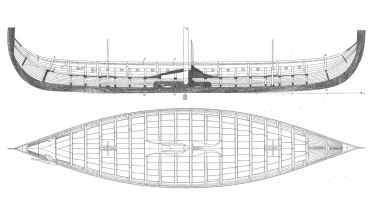
Now we have to work out how to reconstruct the topsides for the Syrakousia.
Now it is necessary to refer back to Athenaeus for what he says about Syrakousia.
' with three gangways. the lowest gangway which it contained led to cargo, the descent to which was afforded by companion-ways of solid construction; the second was designed for the use of those who wished to enter the cabins; after this came the third and last, which was for men posted under arms. .'
' On both sides of the ship were projecting beams, at proper intervals apart; on these were constructed receptacles for wood, ovens, kitchens, handmills, and several other utensils. Outside, a row of colossi, nine feet high, ran round the ship; these supported the upper weight and the triglyph, all standing at proper intervals apart.
' A wall with battlements and decks athwart the ship was built on supports; on this stood a stone-hurler, which could shoot by its own power a stone weighing one hundred and eighty pounds or a javelin eighteen feet long.
Á lot to take in ..and there is more we will consider later.
The first part to look at is the RED text about projecting beams. These would be thwarts set across the topwale of the main hull. This had been launched after it was sheathed in lead to protect it against ship worm. These thwarts would support the main deck. This level was above normal wave height and we might imagine it a metre or so above the waterline.
These beam ends could project out a metre or so. On these beams were booths and huts for the various ancilliary functions of baking, and food preparation and storage of gear. There is no need to imagine that these lockers ran the whole length of the ship.
Also standing on these beams were 'kolossoi' - male statues in conservative poses - These were like caryatids, they had a structural function as pillars or columns. They were 6 cubits high or 3 metres.
This gives a height for the next deck over the main deck - maybe. All around the main deck were these male statues - painted wood, one presumes. They must have stood higher than the booths or lockers we mentioned before, or they stood outside of them.
The kolossoi supported 'the triglyph'. This is part of the entablature of a classical temple. This must have been a detail around the overlying deck edge. Only the Doric order has a triglyph so we must assume other ornament would be as severe and simple as to fit with this style.
HOW MANY DECKS? - A VERTICAL CROSS-SECTION
Athenaeus (or Moschion) tells us (BLUE text above) there were three gangways, one above the other.
If we take one to be at the level of the main deck then there were two above that one.
The word used is parados - which, on a warship, meant a walkway on the exterior of the ship, later, sometimes formed by the top of an oarbox The parados in a Greek theatre is a side entrance where the chorus can walk out in front of the stage. Again the meaning is that it is open to the view.
Some translations interpret these as entrances or access gangways but this makes no sense if they are side by side when the meaning is obviously that they are above one and other.
So we seem to have a series of verandah-like open-sided decks with rooms/cabins inboard. We must assume a balustrade surrounded the whole to avoid too many man-overboard incidents!
If the gangways/paradosoi are on the outside this adds to the ship's stability because the mass of the cabins is nearer to the centre line.
The hold was reached by 'companionways' or ramps leading down into it from the main deck.
Access between levels must have been achieved by similar sloping ways between the overlying decks, Cargo and passengers cannot have been expected to negotiate ladders adequate for sailors and deck fighters.
This arrangement differs somewhat from that proposed by the most recent reconstruction by Makintosh et al.

Makintosh et al have no main deck - no deck which is secured on the thwarts and topwale of the hull construction before the superstructure is constructed upon it. But they did not construct a vertical cross-section to allow us to see exactly how they configured the decks.
DECK PLANS - HORIZONTAL SECTIONS
The deck we have most information about is the third one, with its stables etc. But we have no information as to how the different facilities were laid out.
The second - middle - deck has a large state room and 30 smaller cabins.
The upper deck has a temple, stables etc !!! How could they be laid out ?
Makintosh et al made a basic guess without going too much into details..
DECK 2
After Moschion's account, Athenaeus writes ....
Belonging to the middle gangway were cabins for men ranged on each side of the ship, large enough for four couches, and numbering thirty. The officers' cabin could hold fifteen couches and contained three apartments of the size of three couches; that toward the stern was the cooks' galley. All these rooms had a tessellated flooring made of a variety of stones, in the pattern of which was wonderfully wrought the entire story of the Iliad; also in the furniture, the ceiling, and the doors all these themes were artfully represented.
The gangways I already decided were on the outside.
The cabins divided in two rows, back to back, with doors to the outside gangways, formed the main area and then, to the stern was the larger cabin with its smaller ancilliary rooms, including the kitchen.
The couches spoken of were couches on which one reclined to eat or sleep. Their size can be found in other ancient sources and by supposition.
A couch should be at least 2 metres long and 1 wide, say. Makintosh et al used a size of 6 x 2.5 feet. - 180 by 75cm. A crucial thing might be to include some space to move around in the cabin - which Makintosh et al did not do....jokes about modern shoebox houses aside.. this is surely wrong.
We must allow at least the same space as a couch to allow people to actually move around the cabin.
Notwithstanding they also got the calculation wrong - using 4x6x2.5 as 102 square feet rather than 60, for example, a cabin with 4 couches 1.8 by .75 metres plus an equivalent amount of floorspace comes out at 10.8 square metres. (116.25 square feet).
The couches referred to here are the bed-like furnitures used for eating in a reclined posture - and for sleeping on at a pinch.

A room could be decsribed as having space for x couches. even if there was no standard couch size the approximation was useful for comparisons.

A cabin with couches arranged like this would have space under the couches for gear and a central table plus space to moave around.
Our ypothetical cabin with additional floorspace alongside each couch equal to its area
1,8 x ,75 = 2.7 square metres per couch
Ancient examples give larger figures for palatial dining rooms...
At Vergina, the Macedonian Royal Palace, 7 couches per 25 square metres = 3.6 square metres per couch +/-
At Perachora, Corinthia, 11 couches per 40 square metres = 3.6 square metres per couch
A four-couch cabin on Syrakousia could look like this...
Let's take 3 square metres per couch....this means 12 square metres which is a nice approximation of a 3m square for each cabin's footprint. (square root of 12 is 3.4 - allows for walls )
Our overall deck area is 64 metres length minus 1/7 for bow and 1/7 for stern by 16 metres wide.
9 metres at each end is lost as bow-stern areas, for now.
64 - 18 (x 16) gives us 736 square metres minus a 9 metre bow and stern section.
30 cabins this size(12 sq m) use up 360 square metres. We have to add the stateroom so maybe our size estimates should be pared down, but we are in the right ball-park.
The parados around the deck - could be now 5 metres on each side ...lots of spare room to play with.
So let us relax constraints on the cabins to make them 4 metres wide by 3 metres . More room to swing the proverbial cats in now. Leaving 2metre exterior gangways on each side..
Now for the state suite. Captain's cabins?
This is a biggy with 15 couch space and 3 cubicles of 1 couch size - or of each 3 couch size...depending on translation.
This is 15 x 2.5 square metres plus 3 cubicles of (3 x 2.5) sqm. 37.5 plus 22.5 = 60 sqm c. 8m square
W can shove the 4-couch cabins along a bit and still have space for the state-rooms AND the galley on the end.....
- Makintosh et al place the stateroom in the centre line of the deck . If it is square this is about 8 metres wide . Add 2 gangways at 1.5 metres and two 4-couch cabins as per their diagram - this is 3.5m width each -this is 10 metresof width, we have 18 metres of deck width. Somehwat exceeding their calculated width of 50 feet or 15 metres. They also go in for ball-park-ism.

To this we must add a kitchen at the rear - galleys seem to have usually been located aft in ancient freighters. In size terms it could be reckoned at another 4-couch cabin maybe.
Makintosh et al calculated Deck 2 as extending to 720 square metres (just 700 metres in another place..quite confusing) ......with the facilities taking up 461 square metres.
If we want to add the foreship and aftship areas we can count them as simple triangles and consider half of these parts of the simple rectangle available ..
This extends our deck square metres available by 219.
There is ample space for a gangway if we squish the cabins out to the ends of deck 3 and slim them down a smidgin...
64 x 2 x 1.5 = 196 square metres needed for gangways/paradosoi
SEE C) ON FIGURE ABOVE
The height of the overhead on this deck does not have to be the 3 metres - 6 cubits given for Deck 1 which was surrounded by the kolossoi. We could redcue overheads to 2 metres - or 2.5 with no great problem. Thus saving on top weight.
In summary : our deck arrangements have been worked out to be economical with space.
The basic principle is to imagine the ancient ship as more of a Nile steamer than a modern cruiser with internal gangways.
M.V. Sudan is 72 metres long. Not so different from Syrakousia. She is slimmer than Syrakousia - only 10 metres in the beam. She has 23 cabins, 5 are large state suites. I would suggest that this is the more accurate impression of what Syrakousia looked like rather than HMS Victory or Noah's ark.
NEXT : DECK 3
 |
| Just a simple matter of putting the top bits on... |
Now it is necessary to refer back to Athenaeus for what he says about Syrakousia.
' with three gangways. the lowest gangway which it contained led to cargo, the descent to which was afforded by companion-ways of solid construction; the second was designed for the use of those who wished to enter the cabins; after this came the third and last, which was for men posted under arms. .'
' On both sides of the ship were projecting beams, at proper intervals apart; on these were constructed receptacles for wood, ovens, kitchens, handmills, and several other utensils. Outside, a row of colossi, nine feet high, ran round the ship; these supported the upper weight and the triglyph, all standing at proper intervals apart.
' A wall with battlements and decks athwart the ship was built on supports; on this stood a stone-hurler, which could shoot by its own power a stone weighing one hundred and eighty pounds or a javelin eighteen feet long.
Á lot to take in ..and there is more we will consider later.
The first part to look at is the RED text about projecting beams. These would be thwarts set across the topwale of the main hull. This had been launched after it was sheathed in lead to protect it against ship worm. These thwarts would support the main deck. This level was above normal wave height and we might imagine it a metre or so above the waterline.
These beam ends could project out a metre or so. On these beams were booths and huts for the various ancilliary functions of baking, and food preparation and storage of gear. There is no need to imagine that these lockers ran the whole length of the ship.
Also standing on these beams were 'kolossoi' - male statues in conservative poses - These were like caryatids, they had a structural function as pillars or columns. They were 6 cubits high or 3 metres.
This gives a height for the next deck over the main deck - maybe. All around the main deck were these male statues - painted wood, one presumes. They must have stood higher than the booths or lockers we mentioned before, or they stood outside of them.
 |
| karyatids on the Erectheum at Athens. The male version resembled Rhodes' famous statue to Helios maybe. |
The kolossoi supported 'the triglyph'. This is part of the entablature of a classical temple. This must have been a detail around the overlying deck edge. Only the Doric order has a triglyph so we must assume other ornament would be as severe and simple as to fit with this style.
 |
| Triglyph with metopes - gaps between - Kolossoi would replace the column here shown |
HOW MANY DECKS? - A VERTICAL CROSS-SECTION
Athenaeus (or Moschion) tells us (BLUE text above) there were three gangways, one above the other.
If we take one to be at the level of the main deck then there were two above that one.
The word used is parados - which, on a warship, meant a walkway on the exterior of the ship, later, sometimes formed by the top of an oarbox The parados in a Greek theatre is a side entrance where the chorus can walk out in front of the stage. Again the meaning is that it is open to the view.
Some translations interpret these as entrances or access gangways but this makes no sense if they are side by side when the meaning is obviously that they are above one and other.
So we seem to have a series of verandah-like open-sided decks with rooms/cabins inboard. We must assume a balustrade surrounded the whole to avoid too many man-overboard incidents!
If the gangways/paradosoi are on the outside this adds to the ship's stability because the mass of the cabins is nearer to the centre line.
The hold was reached by 'companionways' or ramps leading down into it from the main deck.
Access between levels must have been achieved by similar sloping ways between the overlying decks, Cargo and passengers cannot have been expected to negotiate ladders adequate for sailors and deck fighters.
 |
| The lockers/booths on deck 1 could be inside the supports but I suspect they should be between them and not necessarily all the way around the ship. 'Outside' means the kolossoi were on the exterior of the superstructure. I think. |
This arrangement differs somewhat from that proposed by the most recent reconstruction by Makintosh et al.

Makintosh et al have no main deck - no deck which is secured on the thwarts and topwale of the hull construction before the superstructure is constructed upon it. But they did not construct a vertical cross-section to allow us to see exactly how they configured the decks.
DECK PLANS - HORIZONTAL SECTIONS
The deck we have most information about is the third one, with its stables etc. But we have no information as to how the different facilities were laid out.
The second - middle - deck has a large state room and 30 smaller cabins.
The upper deck has a temple, stables etc !!! How could they be laid out ?
Makintosh et al made a basic guess without going too much into details..
 |
| CABINS SPLIT TO BOTH SIDES, STATEROOM PUT IN CENTRE ( no galley for state suite ? ) |
DECK 2
After Moschion's account, Athenaeus writes ....
Belonging to the middle gangway were cabins for men ranged on each side of the ship, large enough for four couches, and numbering thirty. The officers' cabin could hold fifteen couches and contained three apartments of the size of three couches; that toward the stern was the cooks' galley. All these rooms had a tessellated flooring made of a variety of stones, in the pattern of which was wonderfully wrought the entire story of the Iliad; also in the furniture, the ceiling, and the doors all these themes were artfully represented.
The gangways I already decided were on the outside.
The cabins divided in two rows, back to back, with doors to the outside gangways, formed the main area and then, to the stern was the larger cabin with its smaller ancilliary rooms, including the kitchen.
The couches spoken of were couches on which one reclined to eat or sleep. Their size can be found in other ancient sources and by supposition.
A couch should be at least 2 metres long and 1 wide, say. Makintosh et al used a size of 6 x 2.5 feet. - 180 by 75cm. A crucial thing might be to include some space to move around in the cabin - which Makintosh et al did not do....jokes about modern shoebox houses aside.. this is surely wrong.
 |
| cat swinging somewhat restricted in second class |
We must allow at least the same space as a couch to allow people to actually move around the cabin.
Notwithstanding they also got the calculation wrong - using 4x6x2.5 as 102 square feet rather than 60, for example, a cabin with 4 couches 1.8 by .75 metres plus an equivalent amount of floorspace comes out at 10.8 square metres. (116.25 square feet).
The couches referred to here are the bed-like furnitures used for eating in a reclined posture - and for sleeping on at a pinch.

A room could be decsribed as having space for x couches. even if there was no standard couch size the approximation was useful for comparisons.

A cabin with couches arranged like this would have space under the couches for gear and a central table plus space to moave around.
Our ypothetical cabin with additional floorspace alongside each couch equal to its area
1,8 x ,75 = 2.7 square metres per couch
Ancient examples give larger figures for palatial dining rooms...
At Vergina, the Macedonian Royal Palace, 7 couches per 25 square metres = 3.6 square metres per couch +/-
At Perachora, Corinthia, 11 couches per 40 square metres = 3.6 square metres per couch
A four-couch cabin on Syrakousia could look like this...
 |
| 14.4 square metres : cabin side 3.8 metres |
Let's take 3 square metres per couch....this means 12 square metres which is a nice approximation of a 3m square for each cabin's footprint. (square root of 12 is 3.4 - allows for walls )
Our overall deck area is 64 metres length minus 1/7 for bow and 1/7 for stern by 16 metres wide.
9 metres at each end is lost as bow-stern areas, for now.
64 - 18 (x 16) gives us 736 square metres minus a 9 metre bow and stern section.
30 cabins this size(12 sq m) use up 360 square metres. We have to add the stateroom so maybe our size estimates should be pared down, but we are in the right ball-park.
The parados around the deck - could be now 5 metres on each side ...lots of spare room to play with.
So let us relax constraints on the cabins to make them 4 metres wide by 3 metres . More room to swing the proverbial cats in now. Leaving 2metre exterior gangways on each side..
 |
| DECK CONFIGURATIONS : A) CABINS,B) ADDING STATE ROOM, C) FINAL VERSION |
Now for the state suite. Captain's cabins?
This is a biggy with 15 couch space and 3 cubicles of 1 couch size - or of each 3 couch size...depending on translation.
This is 15 x 2.5 square metres plus 3 cubicles of (3 x 2.5) sqm. 37.5 plus 22.5 = 60 sqm c. 8m square
W can shove the 4-couch cabins along a bit and still have space for the state-rooms AND the galley on the end.....
- Makintosh et al place the stateroom in the centre line of the deck . If it is square this is about 8 metres wide . Add 2 gangways at 1.5 metres and two 4-couch cabins as per their diagram - this is 3.5m width each -this is 10 metresof width, we have 18 metres of deck width. Somehwat exceeding their calculated width of 50 feet or 15 metres. They also go in for ball-park-ism.

To this we must add a kitchen at the rear - galleys seem to have usually been located aft in ancient freighters. In size terms it could be reckoned at another 4-couch cabin maybe.
Makintosh et al calculated Deck 2 as extending to 720 square metres (just 700 metres in another place..quite confusing) ......with the facilities taking up 461 square metres.
If we want to add the foreship and aftship areas we can count them as simple triangles and consider half of these parts of the simple rectangle available ..
This extends our deck square metres available by 219.
There is ample space for a gangway if we squish the cabins out to the ends of deck 3 and slim them down a smidgin...
64 x 2 x 1.5 = 196 square metres needed for gangways/paradosoi
SEE C) ON FIGURE ABOVE
The height of the overhead on this deck does not have to be the 3 metres - 6 cubits given for Deck 1 which was surrounded by the kolossoi. We could redcue overheads to 2 metres - or 2.5 with no great problem. Thus saving on top weight.
In summary : our deck arrangements have been worked out to be economical with space.
The basic principle is to imagine the ancient ship as more of a Nile steamer than a modern cruiser with internal gangways.
 |
| Syrakousia was not so much this........ |
 |
| ..but this..... |
M.V. Sudan is 72 metres long. Not so different from Syrakousia. She is slimmer than Syrakousia - only 10 metres in the beam. She has 23 cabins, 5 are large state suites. I would suggest that this is the more accurate impression of what Syrakousia looked like rather than HMS Victory or Noah's ark.
NEXT : DECK 3