Friday, 24 April 2020

THE RAM THAT TIME FORGOT

The Egadi rams have received most attention in recent years due to their spectacular number and direct association with the battle of the Aegetes Islands which effectively ended the First Punic War.

But in September 2008 another ram was found off Sicily but near Messina. This is the Aqualadrone Ram, which has languished in that familiar state of being written-up for publication. 12 years later I cannot find so much to write about..... I have personal reasons for wanting this ram published but ..maybe next year ?
Aqualadrone ram :cleaned-up

The ram was found in very shallow water - just 6 metres deep - and just 200m offshore !! In an area of low erosion so it was preserved by lucky conditions. Like the Athlit ram its supporting timbers were preserved from rotting sealed inside the bronze ram.
ram supports - 2300 years old!
The ram was recovered by Italian Navy diversand preserved by desalination and in a constant stream of deionised water in a plastic box.
More fotos HERE
There was plenty of wood for C-14 dating and this revealed a date of 277BC +/- 83. Which ties in nicely with the early days of the First Punic War. The battles of Mylae and Tyndaris were fought not far away and the ship could have sunk running for Messina harbour or in a combat during flight from either battle.

Problems of preservation continue because the wood includes much sulphur from the anaeobic conditions of preservation which now threatens to convert to sulphuric acid in aerobic conditions and attack the wood and the ram.

The ram has the same ornament modelled into the casting as the other trident rams found to date. The side of the cowl is modelled as a trident - the weapon of Poseidon -  with the three blades arising from a socket/handle at the rear.

 For details of inscriptions or any other ornament we must wait for publication. The Athlit ram took 11 years to emerge in print...

Some physical and chemical analysis has been carried out on the bronze and the wooden core remains. The supporting timbers appear to have the same arrangement as the Athlit ram.

the monster from Athlit
Analysis shows the wood to be pine but the exact type could not be determined.Pine was a preferred wood for warships where fir was unobtainable. The keel was made of oak for strength and wearing but it was not found here.

The presence of pine pitch was confirmed which was probably used as a preservative on the wood.

Luvlyjubly - can smell it now! Years of tar on a viking ship's planking


From lead isotope analysis the bronze originated in Spain or Cyprus.
Analysis paper HERE


The ram's dimensions are only estimated here:

WEIGHT 200Kg     LENGTH 100CM estimated    HEIGHT 80cm estimated.

The ram is nowhere near as large as the Athlit ram and is similar to Egadi 1 or 2. This makes it more likely to belong to a smaller ship. A 3 or pentekonter.

Thursday, 16 April 2020

SEA SERPENTS and WWF not Corona and WHO

Whilst banging on about various weapons used at sea with Syrakousia I must just collect a few notes I have had for ages about even more exotic things. The use of wildlife for everything possible is not just a Chinese trait. In the ancient world anything nasty could be used as a a biological weapon. We are not talking about zoonoses here , just the zoo bit.

https://66.media.tumblr.com/118865a8911bb697658a34eeffabbdb8/tumblr_nkgy3wJvGO1u6oeoao2_r1_1280.jpg
Read more about chucking invertebrates as a form of warfare HERE
 In his later career, the great Hannibal was forced to take employment as a jobbing, zero-hours, gigging, independant, external military consultant with Antiochous the Great of the Seleucid Kingdom. Knowing of Hannibals' great gifts as a land general Antiochous put him in charge of a fleet. It did not go well. Worried Antiochous was going to betray him to the Romans Hannibal burn this contract and signed  on with Prusias of Bithynia
(Is that what he said to Antiochous ? Ed.).
Undismayed by Hannibal's record on the briney, Prusias sent him to fight the Pergamenes,     at sea.

From Cornelius Nepos 'The Lives of the Great Commanders : Hannibal'

 ' They were to engage by sea in a few days; Hannibal was inferior in number of vessels, and had to use art in the contest, as he was no match for his enemy in force. He accordingly ordered as many poisonous serpents as possible to be brought together alive, and to be put into earthen vessels, of which when he bad collected a large number, he called the officers of his ships together, on the day on which he was going to fight at sea, and directed them all to make an attack upon the single ship of King Eumenes, and to be content with simply defending themselves against others, as they might easily do with the aid of the vast number of serpents;.........
 
......As the rest of the Pergamenian ships bore hard upon the enemy, the earthen pots, of which we have previously spoken, began suddenly to be hurled into them. These, when thrown, at first excited laughter among the combatants, nor could it be conceived why such a thing was done; but when they saw their ships filled with serpents, and, startled at the strangeness of the occurrence, knew not what to avoid first, they put about their ships, and retreated to their camp upon the coast '

Thus Hannibal achieved another victory by indirect means...

But the other star of the story is the snake ! And after years of obscurity, shunning the limelight - and the daylight-  it was found.. maybe.In Romania..in 2013
Link HERE
and in Sicily......in 2015

Link HERE
Actually it is not rare... just rare at the margins of its distribution, as all species tend to be...


But this snake was apparently used AS A PROJECTILE

 ' Scientists in Italy have come across the Javelin Sand Boa, a type of snake that the ancient Greeks used to hurl at their enemies as a projectile to create panic and confusion during sea battles.'

 Maybe a confusion with its species name which literally means 'throwable' but has been changed into its common name which is 'Javelin Boa'. Still a very throwy name.

Chucking them could be a problem - wriggly floppy snakes.. 

Maybe they fed them with Viagra before loading them into the catapults ?

sub-species Eryx jaculus ballisticus
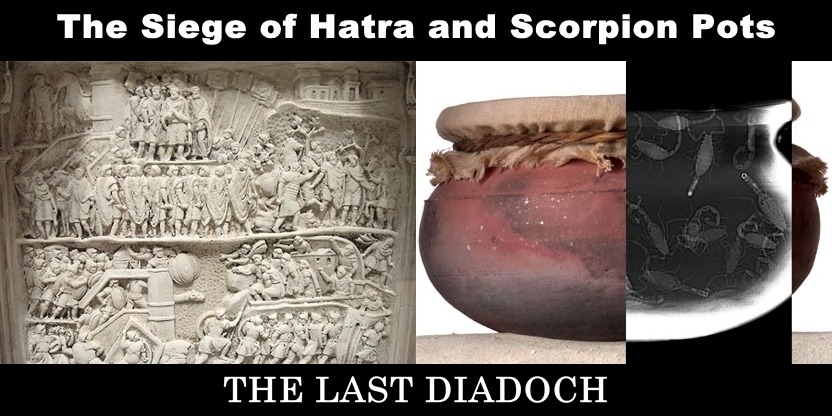
 The truth is that they were immured in pots and the pots were thrown or shot to break and release the deadly serpents within so they could rampage through the packed ranks of rowers in the unfortunate Pergamene war-galleys.

In the ancient world it is was common to keep edible dormice in pots.
So the concept of pre-packaged delivery systems was nothing new.

Like this only snakier .. or do I mean less ..snacky, If I was a Roman..

WWWWAAAIIITTTTTT!!!!!  ' Deadly serpents' !!???

Eryx jaculus - family Boidea - a boa. Boas are non-venemous. They crush their prey..this snake was how big ?  80cm ? !!!
VIPERS ABOVE  :  BOAS BELOW

 OK, no one ever remembers hearing 'Hannibal the Herpetologist who crossed the Alps with 100,000 men and a load of snakes' do they?   It was a unique error of judgement to incite serpenticide.  He is innocent. I blame the newspapers.

No Hannibal..... no no no ! They are on the WWF Red List ..not for use in warfare !

Actually, Hannibal was doing the Pergamenes a favour and treating their fleet to an antique version of a Rentokil visit. A shower of Eryx jaculus would do something to reduce the rodent population onboard a war-galley even if it did not take a toll on the crew!


Now, can we have some other candidates for Hannibal's snake ?  A viper of some kind ?

Contact details at Reprile Database .. HERE
Here is our boy ! A metre of viper with deadly venom - the Ottoman Viper, Montivipera xanthia.

Like Monty, doesn't suffer fools gladly. A touch aggressive if irritated. Range is eastern Aegean and eastern Turkey... fits the bill.
Now the small question of rounding them up and getting them into the pots.......

Monday, 6 April 2020

SYRACOUSIA VI : DON'T GIVE UP THE SHIP!


DEFENDING THE SHIP

 There were also eight turrets on it, of a size proportional to the weight of the ship; two at the stern, an equal number at the bow, and the rest amidships. 
To each of these two cranes were made fast, and over them portholes were built, through which stones could be hurled at an enemy sailing underneath. 
Upon each of the turrets were mounted four sturdy men in full armour, and two archers. The whole interior of the turrets was full of Saracen and missiles. 


TURRETS

These turrets have been interpreted as full height towers. This is not necessary. The meaning is a fighting platform. They were not massive - they housed just 4 men and their ammunition. 4 metres square would give ample fighting space plus some racks for amunition.
 
Ship tower a la Ben Hur. Nice, but practical?

A light wall around them would deflect missiles and they could be furnished with machiolation. Sculptures suggest they could be painted to resemble stone-built structure but this is not definite at this early date.

Maybe more like this..fighting platforms not Rapunzel towers
 The 'Saracen'  mentioned here is, I believe, tow-like fibre which can be easily lit. Presumably for making fire missiles.

STONE-DROPPING CRANES

The crane weapons are interesting. They are designed to prevent smaller craft coming alongside - as pirates are wont to do.


The ammunition must be lifted by 2 men by hand so we must assume the calibre was around 1 or 2 talents  25 or 50 pounds, 12 or 25 kilos.(approx.)

Such stones falling 10 metres would have considerable force to crush men or spring planks in a small hull.


The weapon is interesting because it has some parallel with the Theban 'flamethrower' used at the siege of  Delium in  424BC. This was also made of 'beams' hollowed.

There was plenty of ammunition supplied and it would be a brave attacker who came alongside Syrakousia.


MAST-CRANES AND DOLPHINS

 and as there were three masts, from each of them were suspended two large yards bearing stones, from which hooks and leaden weights were let down upon any enemy which might attack the vessel.

Each mast had men serving lines and pulleys which controlled extra yardarms - cranes - which allowed dolphins to be suspended out beyond the ship's sides. Dolphins were an old weapon, used,  not for the first time, at Syracuse in the Peloponnesian Wars.

The principle was similar to the turret cranes, in that a targetted vessel would suffer a heavy weight smashing vertically down into it in free fall. Dolphins could be random heavy things but, in the absence of grand pianos and ton weights the ancients used torpedo or dolphin-shaped lead castings.


ACME is a Greek word, you know? Doesn't lessen the pain though..
 The dolphin was raised to the top of the yard, the yard steered round to hang over the target - probably aimed using a hanging plumb bob - and then released by pulling a pin or slipping a line. Maybe the dolphin could be hauled up for another shot, otherwise it would be cut away and another hoisted.


The same yard crane could deploy an iron hand / grapnel to catch a target and capsize it or hold it for others to attack at will.


 FIGHTING DECK - AN EXTRA DECK OR 1 OF THE 3 ?

A wall with battlements and decks athwart the ship was built on supports;

 Here we read that there was also kind of combat deck on the ship.

This is added to the 3 decks already mentioned. But as we shall see was not a complete deck.

A question arises as to if this was intended to refer to an extra superimposed structure or a specific part of the uppermost deck.

It seems to be an overlying structure because ..

a) the structures on deck 3 needed roofs and this platform could form their roofs.
b) the structure is described as being supported on trestles/tripods  (rather than the columns/pillars of this translation)

The description of a 'wall' crossing the ship is confusing...maybe it refers to the  fore and aft aspects presenting wall-like balustrades? Difficult to interpret.

The platform - which we can call Deck 3A - cannot have extended over the whole of the area of deck 3 because this would cover the promenades, gardens and gymnasium areas which Moschion was so keen to describe.

Deck fighters at this height on the ship  could only hurl missiles or wait to rush to places where attackers had breached the all-round barrior of  iron railings.

Attackers would not need to climb to the top deck. If they got aboard they would be distracted prior to that by the prospect of plundering cabins cargo and passengers while the deck fighters could be left to stew in the sun.
'Chaps, chaps.. I say..there are some steps just over here....

Each mast base needed an area for the mast and tops to be serviced. The large catapult needed a base to operate on and probably to be moved and trained in different directions.

The stables needed roofing. As did the library and reading room - though the roof of this had a circular hole for a sundial. Areas covered by the towers - 8 of them - would not necessarily need a fighting deck at those locations.

The solution would appear to be that there were katastroma-like  strips of decking located at crucial areas over the hull area. Early galleys were not fully decked, they had a narrow gangway down the mid-line connecting forecastle and poop. It is something like this we could see as Deck 3A on Syrakousia.
early undecked pentekonter, later eikosoros with through-gangway

schematic of fighting platform over Syrakousia's top deck
This is a difficult aspect of the reconstruction but we can be sure it was not a true extra deck.

Archimedes' Catapult
on this stood a stone-hurler, which could shoot by its own power a stone weighing one hundred and eighty pounds or a javelin eighteen feet long  This engine was constructed by Archimedes. Either one of these missiles could be hurled six hundred feet.

..this I will save for next time... plenty to deal with besides this....


After this came leather curtains joined together, suspended to thick beams by means of bronze chains. 

Such screens were a common device to block incoming missiles. They were bronze and heavy leather to avoid damage and absorb the energy of the  missiles. They are mentioned in the surviving treatises on siegecarft and artillery but we do not know exactly how they were made. A flexible and heavy hanging mat would catch flying missiles and absorb their force without itself suffering too much.


If you know what I mean....


An iron paling which encircled the ship also protected it against any who attempted to climb aboard; 

I have searched for surviving iron railings from the period or even Roman times without success. Iron is, alas, too -easily recycled for such mundane items to survive the centuries. One might be put in mind of the abbatis-like cervi of Caesar's circumvallation of Alesia whenh considering how these pailings functioned.


Railings could even be put into offensive action if one is so minded. Kubrick shows us how in his spectacle 'Spartacus'.
Some great railing action with Kirk HERE


also grappling-cranes of iron were all about the ship, which, operated by machinery, could lay hold of the enemy's hulls and bring them alongside where they would be exposed to blows.

These smaller versions of the mast-cranes or perhaps even catapult propelled grapnels made it dangerous for small vessels to approach Syrakousia. I have discussed the harpax, which is otherwise assumed to have been devised by Agrippa, Octavian's admiral, centuries later, in a previous post HERE


Sixty sturdy men in full armour mounted guard on each side of the ship, and a number equal to these manned the masts and stone-hurlers. 

This means there were 120 armed deck fighters manning the ship. There were cabins for them somewhere or else they must have sheltered under awnings on the deck or fighting platforms. It is interesting what the passengers made of 120 plus warriors milling around the place.

Jenkins rued the ticket price for his week on the Zambezi river considering the limited privacy the vessel afforded

Also at the masts, on the mast-heads (which were of bronze), men were posted, three on the foremast, two in the maintop and one on the mizzenmast; these were kept supplied by the slaves with stones and missiles carried aloft in wicker baskets to the crow's-nests by means of pulleys.

Syrakousia's 'fighting tops' were not the large, heavily-manned platforms of the 'age of sail'.


But they surely could deal some damage as the men up there were relatively immune from attack and well-supplied with missiles which would have serious effect when thrown from such a lofty perch.


Sluys 1340. Gravity still a potential threat.

DEFENSIVE STRATEGY

Syrakousia seems to have been designed with the idea of primarily keeping attackers at a distance. It would have been extremely dangerous for smaller craft, less than a trieres in size, to approach Syrakousia. This is consistent with the main threat being piractes rather than warships. Pirates operated with vessels that could be used as fishing boats when the owners cupboards were not bare enough to have their wives place a cutlass or grapnel on the dining table one evening.

Small vessels with clusters of desperate men aboard,  appearing form behind headlands were the pirate's mode of attack. Several vessels could cooperate to corner a victim. The denouement was when a wave of badly dressed expert sailors swarmed onto the cornered vessel and waved very sharp agricultural instrument under the noses of the occupants who had not already had a siezure or jumped overboard.
Who is tractoring who ?

To be taken by pirates meant certain slavery, possible ransoming, rape of all denominations and death or mutilation for the uncooperative or unlucky. Not to mention the loss of the cargo and the ship. Hence defence.


Along each side there were 7 crane weapons which could reach out several metres. There were the tractor beams . the grapnel thrower - which could drag unwary attackers close.


There were 60 deck fighters chucking javelins, stones and shooting arrows on each side.

 
Cruel, yet satisfying.

 If the attackers got alongside they had to climb a spiked iron railing under shot and spear-thrust.


Once aboard, the crew of 600 ( ! ? ) would resist. Added-to the occasional sharpened hairpin or aggressive lapdog of the first class passengers this is a lot of manpower.


10 or 20 cutthroats would steer clear of Syrakousia. Several boat-loads of pirates would not bother with Syrakousia. It would take a major combined effort  of several settlements or a state-backed episode of privateering to think about tackling Syrakousia! Unfortunately such shady enterprises were usual along the rugged coasts of the Mediterranean. Hence, Syrakousia was such a bonney girl.
Beautiful lines, full form, comfortable ride, but sharp talons and expensive to maintain : Pirate keep your distance!!!

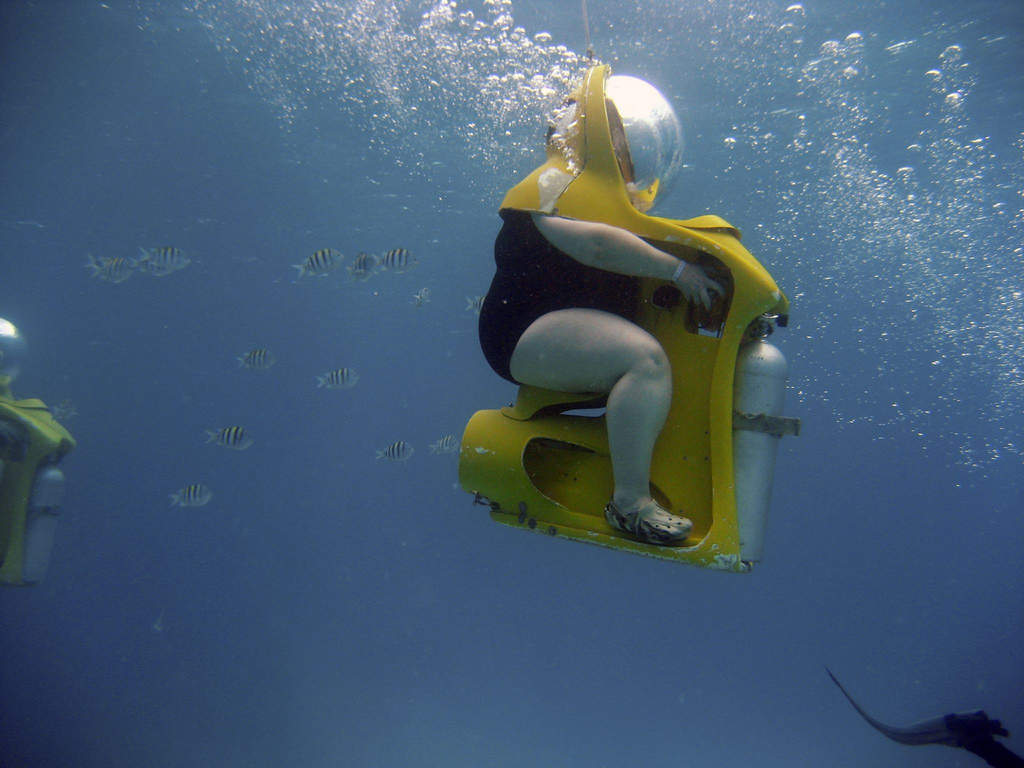
 Had they but world enough and time no doubt Hieron's brains trust could have devised anything. The only way to secure her cargo better would have been to make Syrakousia a U-boat. Looking at the early models such as Turtle and the Holland, and considering Aristotle's observations about snorkels or breathing lines.....


Just then as divers are sometimes provided with instruments for respiration, through which they can  draw air from above thewater, and thus may remain for a long time under the sea,so  also elephants have been furnished with their lenghened nose wherever they have to traverse the water they lift its tip up above the surface and breathe through it. For the elephant's proboscis as already said, is a nose. 
(Aristotle, de partibus animalium, Part ii.16:658b30 f.)

Probably it was the plans for a u-boat which a Roman soldier stood on as he butchered Archimedes.
Alexander is reputed to have gone down in a diving bell, maybe even with Aristotle, at Tyre. Sadly,  this story has no historical foundation. 
But Syrakousia proves, truth is usually stranger than fiction....

Saturday, 4 April 2020

RAMMING IS NEVER OUT OF FASHION

On 30 March last, a Venezuelan navy patrol ship - 80m Naiguata -


has tried to divert a cruise ship.. RCGS Resolute off its course. By nudging it round at the bow....


This took place off the north coast of Venezuela near  La Tortuga.  Some kind of misunderstanding..

Unfortunately Resolute has a hull reinforced for polar ice-breaking trips and an ice-breaker bulbous bow....concealed under the waterline.
 
 Lightly built navy ships tend to come off second best against tough hulls as the British navy found during the Cod War ...

Naiguata sank but all hands were saved according to the Venezuelans.

It is incredible behaviour for a navy ship. It is incredible that the Venezuelans had not even looked up their target on the web..as anyone can do .. and seen it was a tough cookie.

This blog approves of the way in which the Venezuelans sought to continue the age old tradition of ramming combat but disavows attacking civilian ships or use of kamikaze tactics.

Thursday, 2 April 2020

SYRAKOUSIA V : THE AMAZING TOP DECK

DECK 3 - THE FLOATING GARDENS OF HEIRON

The top deck as described by Athenaeus-Moschion was a truly amazing conglomeration of facilities that sounds more like a small town than a ship. Here we begin to imagine parallels with the barges of Caligula and the Ptolematic thalamegoi.

Here is the text .. it is difficult to translate and cannot be said to make complete sense.

On the level of the uppermost gangway there were a gymnasium and promenades built on a scale proportionate to the size of the ship; 
in these were garden-beds of every sort, luxuriant with plants of marvellous growth, and watered by lead tiles hidden from sight; then there were bowers of white ivy and grape-vines, the roots of which got their nourishment in casks filled with earth, and receiving the same irrigation as the garden-beds. These bowers shaded the promenades. 
Built next to these was a shrine of Aphrodite large enough to contain three couches, with a floor made of agate and other stones, the most beautiful kinds found in the island; it had walls and ceiling of Cyprus-wood, and doors of ivory and fragrant cedar; it was also most lavishly furnished with paintings and statues and drinking-vessels of every shape. 
"Adjoining the Aphrodite room was a library large enough for five couches, the walls and doors of which were made of boxwood; it contained a collection of books, and on the ceiling was a concave dial  made in imitation of the sun-dial on Achradina.  
There was also a bathroom, of three-couch size, with three bronze tubs and a wash-stand of variegated Tauromenian marble, having a capacity of fifty gallons. 
There were also several rooms built for the marines and those who manned the pumps. 
But beside these there were ten stalls for horses on each side of the ship; and next them was the storage-place for the horses' food, and the belongings of the riders and their slaves.  
There was also a water-tank at the bow, which was kept covered and had a capacity of twenty thousand gallons; it was constructed of planks, caulked with pitch and covered with tarpaulins. 
By its side was built a fish-tank enclosed with lead and planks; this was filled with sea-water, and many fish were kept in it.

Let's take Makintosh et al's plan of Deck 3 as a starting point.


Here they opted for central walkways and keeping the different facilities separate. This is not necessary nor logical.

If we continue with the basic principle of keeping weight central and the gangways peripheral we find a simple layout almost draws itself.

We should bear in mind that gangways need sloped sections communicating with the lower levels.


AGGLOMERATED STRUCTURES

I cannot see how  a ship would be built with disparate structures separated on a deck. It makes more sense to build them together to add stiffness to the structure and save on shared walls. Likewise they should be central as possible.


The temple is rather small - equivalent to a 4-couch cabin in all, maybe.
Likewise, there is no reason for the library and reading room to be of any great size.

This leaves us with the gymnasium and baths.

The gymnasium would be an open area with collonaded surrounds, Exercise would be conducted in the central area of sand or grass and the shade used to relax or prepare.

a  full-size gymnasium had many ancilliary rooms to the exercise area. The quad here is 50m square.

teaching and exercise took place in the open or under cover
 The gymnasium on the ship was probably mostly for exercise. We can forget all the extra rooms and think of a collonade around an open area.

 The baths need not be so large. we are not talking of a Roman bath complex , rather a more simple affair. Greek baths had short bath tubs maybe some massage area.

bathtubs of ceramic or metal or stone - one sat on the step
Greek bath complex at Gela - several dont take up much space

 A 3-couch room with 3 bronze tubs could again be equated with a 4 couch cabin.


The library was 5-couch size - scaling up a 4-couch cabin we have something like 4 by 4 metres. It had a complementary reading room of the same size. The two seem to have shared the same roof which was pierced with a circular hole to allow a sundial to stand . The usefulness of a sundial on a ship is dificult to explain, unless there was no plan it should go anywhere... 

The presence of the stables here is very informative. Horse need to be led up onto the top deck. Stairs dont go well with hooves. There must have been ramps. Unless the horses were put aboard by cranes. Unlikely, I imagine. How would they be disembarked in a pinch?

PEOPLE-CARRIER OR HIPPOGOGOS ?

Makintosh et al make no provision for stairwells or ramps on either deck. How did they imagine people and horses moved between decks?

Peripheral paradoi can have ramped sections or even be accessed by a sloped gangplank from the dock.

There is some possibility of having more than 10 horses on each side. Did each stall or stable house more than 1 horse? We can never know. Makintosh et al decided that there were 100 horse because they drew parallels with a medieval salandria used for carrying horses to Outremer. But such a scale is not necessary - and the dung and urine and flatulence of 100 horses does not marry well with pleasure gardens, temples and library reading roomse etc..

A Roman barrack for  cavalry housed 3 horses in about 12 square metres, 3.6m square,  and the troopers and their gear in an equivalent space alongside. This tallies remarkably well with the 4-couch cabin , note.
Reconstruction of the ‘stable-barracks’ at Chesters Roman Fort © English Heritage (drawing by John Ronayne)
A small cavalry unit of 20 men is still useful - or the stables could have been for racing horses or even pack horses !?

If there were 100 horses we must assume there were 100 riders and probably 100 grooms. Plus fodder and gear.

If we have 'Roman size' stalls with 30 horse per side then 60 is still a lot but a lot less than 100!
There is no fundamental reason to require the ship to carry 100 horses.

with Roman barrack size accommodation horses com eto dominate the purpose of the top deck. Can this be true?
The ship was not a horse transporter. 20 horse would be enough for commercial transport or protection of the ship if stranded on a coast.

If we take 1/3 size of the Roman stables maybe that is plenty for our purposes.

The horses must have been closed-in for the duration of the trip and led up ramps for embarkation.

All these structures were roofed to some extent and must have been built to share supporting walls.

The Athenian used old trieres as hippogogoi in the Peloponnesian Wars. The horses were in stalls on the main deck and 30 could be housed in the 38 metres length of a trieres.
from Coates - Athenian Trireme. 1st ed.
But there was no extra gear no grooms etc on this type of transporter which would never stay at sea overnight.

Horses COULD be crammed in to Syrakousia. The question is why would they be ?
To put a hundred horse on a deck upon which so much effort had been spent to make it luxurious seems somehwat perverse. The only way I can imagine the two coul dbe combined is to put the stables at one end and the facilities at the other. Even then, the reality of the pleasure gardens would have been somewhat negatively fragrant. But maybe that was why the flowers and bushes were needed ?  ;)

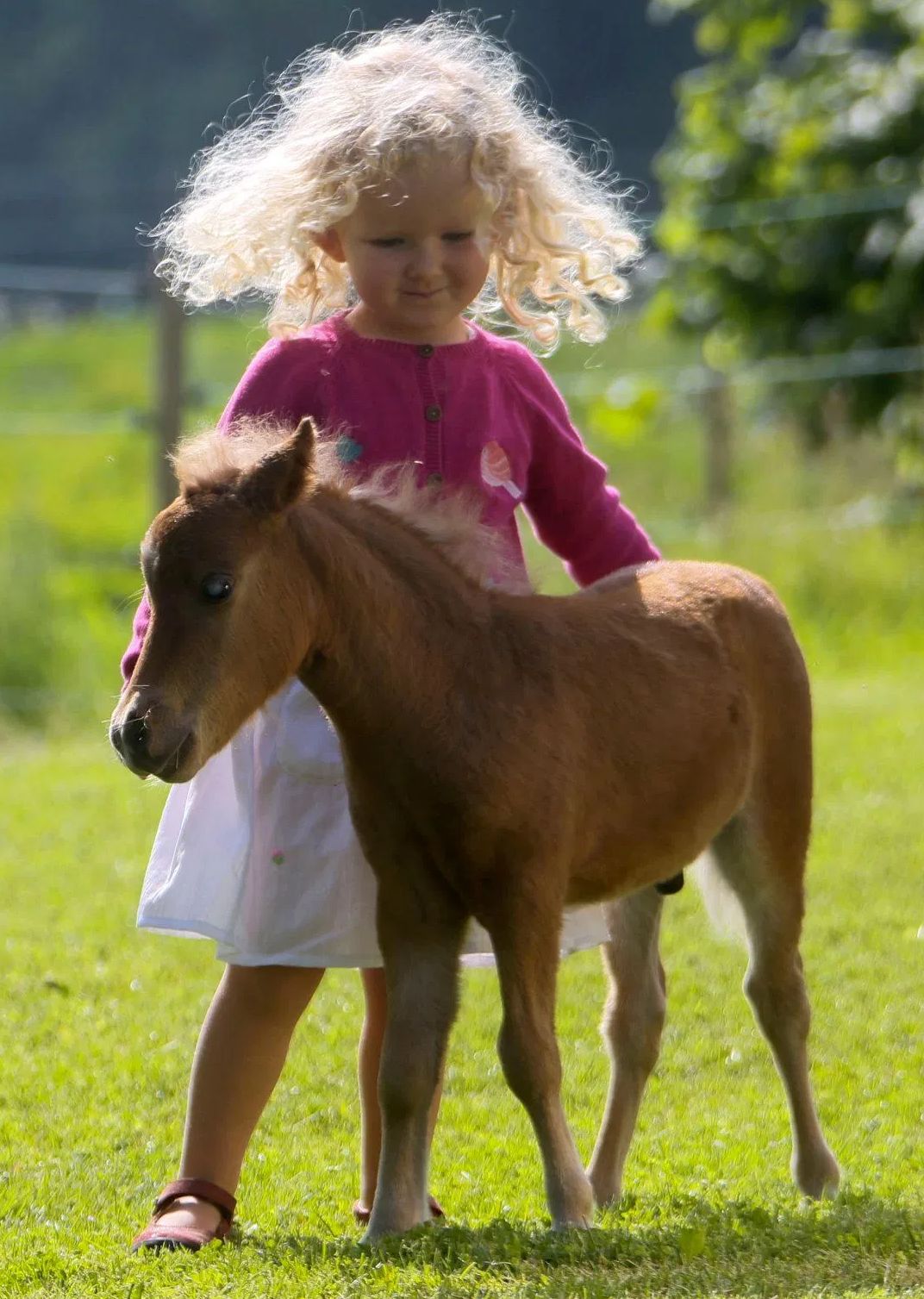
Makintosh et al offered a possible solution..They calculated that 20 horses would occupy 34 square feet. I am not sure what  kind of horse they meant, but even a pony would be hard put to suffer transportation in a trailer-box of just 1.7 square feet. Did you see 'bonsai kittens' ?

Dwarven cavalry as envisaged by METRO.co.uk : still somewhat squished in 1.7 square feet

GARDENS ETC
All the remaining spaces were decked-out as gardens and promenades, watered by a system of pipes. Overhead bowers and palisanders gave shade for the promenders.

Roman garden...


The need for light for the greenery and the function of the greenery as a shade means that Deck 3 was not covered with another structure.
Roman gardens with espaliers and arbor walks.
See also earlier post HERE

THE WATER TANKS

The quantity of water is 20,000 gallons of drinking water plus the aquarium for food fish. A tank for this takes up just 8 by 5 metres if it is 2 metres deep. Maybe the aquarium is smaller.  either way it is not a great space. The tank is supposed to have been in the bows  but it is more sensible to put such a tank close to the centre of gravity of the ship so that it does not begin to move dangerously as the ship pitches. The translation might be off or the amount of water less than we think. But it is also to be remembered that this ship was an exception. An experiment. The tank was closed, so this may have been an attempt to counter movement of the water causing problems.


SUMMARY

Deck 3 was mostly open. It was a pleasure garden type space with greenery and shade against the Mediterranean sun as well as space to walk and exercise. Maybe all structures actually butted up against each other.
Maybe the stables coul dbe at fron tor back, but there is a reason to put them at the centre..see next part.. the horse dung and urine is still somehwat problematic, even for 10 horses. It must have gone over the side.
This open deck would allow for movement of deck fighters and defence of the ship from this level. But there were also extra arrangements for the defence of the Syrakousia. As we shall see.