Naval Warfare with Ancient Galleys : Card model ships, wargame rules and the background for their development : All original material copyright
Showing posts with label EGADI. Show all posts
Monday, 6 July 2020
Sunday, 9 February 2020
Back at the Helm. As in Helmet.
Another special helmet found at Egadi..'...there have been found 2 very fine Montefortino types... with animal crests - along with 4 plain examples.
The first has a reclining cat-like figure ...
Now the second is shown ,cleaned a bit.
It reveals itself to be an ornate Roman type a Montefortino with extra ornamentation. A beautiful gryphon head which may be a holder for another fitting - see the mouth.Somehwat resembling later heavily ornamented cavalry helmets or even some infantry officer helmets. The cavalry and officers, especially in Republican times, had plenty of cash to display their status in their equipment.
There are small feather holdrs on the sides too.
A nice report at Archaeology News Network gives details HERE.
Did it fall overboard as the wearer stumbled under a blow or did it find its way into Davy Jones' Locker still attached to his noble head?
You can read a Master's Thesis about the 6 Montefortino helmetsfrom Egadi HERE
This season has revealed 2 more bronze rostra and a sword ....
.... see RPMN website slide show HERE
You can see video of the recovery operations if you click on this foto.
You can read more about Egadi under my previous posts or at the RPMN website HERE.
The first has a reclining cat-like figure ...
Now the second is shown ,cleaned a bit.
![]() |
| Foto from Archaeology News Network |
It reveals itself to be an ornate Roman type a Montefortino with extra ornamentation. A beautiful gryphon head which may be a holder for another fitting - see the mouth.Somehwat resembling later heavily ornamented cavalry helmets or even some infantry officer helmets. The cavalry and officers, especially in Republican times, had plenty of cash to display their status in their equipment.
There are small feather holdrs on the sides too.
![]() |
| This one shares its knob with the Egadi helm. |
A nice report at Archaeology News Network gives details HERE.
Did it fall overboard as the wearer stumbled under a blow or did it find its way into Davy Jones' Locker still attached to his noble head?
You can read a Master's Thesis about the 6 Montefortino helmetsfrom Egadi HERE
This season has revealed 2 more bronze rostra and a sword ....
.... see RPMN website slide show HERE
You can see video of the recovery operations if you click on this foto.
![]() |
| Click to see video of recovery at TP24 Cultura via Facebook |
Labels:
EGADI,
HELMET,
ILLUSTRATION,
MARINES,
PUNIC WARS,
REPUBLICAN ROMAN,
REPUBLICAN ROMAN NAVY,
RPMN
Tuesday, 2 February 2016
EGADI RAM AT BRITISH MUSEUM
From April the BM have an exhibition about 'Sicily: Culture and Conquest'. It will include one of the Egadi rams - I presume the one illustrated which is Ram 6 I think. 4 and 6 have the interesting history of maybe being reused captured Roman ships sunk by the Romans. A trieres-sized vessel.
Details HERE
ASHMOLEAN UPDATE!
I have heard thathe Ashmolean exhibition, 'Storms War and Shipwrecks' will actually include TWO Egadi rams including the Punic one,
Tuesday, 8 December 2015
Egadi in the Flesh : Storms War and Shipwrecks
Material from the Egadi researches - rams at least - will be on show in the UK next year.
The Ashmolean at Oxford will have an exhibition of maritime materials found around Sicily.
June 21 to September 25
It sound exciting . something to look forward to next summer.
Details HERE
Wednesday, 12 November 2014
CARTHAGINIAN HELMET FROM EGADI
I have finally tracked down a picture of the possible Carthaginian helmet found at the site of the naval Battle of Egadi 241BC - fought off the island of Levanzo off the western coast of Sicily.
The battle site has yielded numerous Montefortino helmets, presumably worn by the Roman combatants.
Then a different helmet was retrieved...
First described as 'conical' and with a nose-guard and broad neck-gaurd, this helmet was thought to be a Carthaginian officer's helmet because it was so different from the 'Roman' ones.
Looking at the photo, which is from Current World Archaeology issue 65 the first thought is of Thraco--Makedonian helmetsfamiliar from the Alexander sarcophagous and many examples sitting in museums.
There appears to be a cut-out for the ear in the middle of the picture. Maybe the back of the helmet is at the left.
There is a flared brim around a carefully raised bowl. This is not a mass-produced item like the pot-like Montefortino helmets.
There appears to be a high Phrygian crest which is damaged.
Evidence for a nasal is hard to see in the photo. Thraco-Makedonian helmets did not necessarily have them.
There was also a Boeotian-Phrygian helmet which would also be a candidate.
These types of helmets with brims for protection but good hearing and visibility would be ideal for use at sea where footing was insecure and fighting could go on in very confused conditions.
Prog. Andrew Goldman of the Egadi Project has stated the helmet is 'without parallel' and may be the 'first example of Carthaginian armour yet found'.
![]() |
| Basemap from RPMN |
The battle site has yielded numerous Montefortino helmets, presumably worn by the Roman combatants.
Then a different helmet was retrieved...
First described as 'conical' and with a nose-guard and broad neck-gaurd, this helmet was thought to be a Carthaginian officer's helmet because it was so different from the 'Roman' ones.
Looking at the photo, which is from Current World Archaeology issue 65 the first thought is of Thraco--Makedonian helmetsfamiliar from the Alexander sarcophagous and many examples sitting in museums.
There appears to be a cut-out for the ear in the middle of the picture. Maybe the back of the helmet is at the left.
![]() |
| Alexandrian hypaspist in colour |
There appears to be a high Phrygian crest which is damaged.
![]() |
| From Danish National Museum |
![]() |
| Etruscan cinerary urn showing Oedopus' sons in combat |
![]() |
| From Rome at war website |
These types of helmets with brims for protection but good hearing and visibility would be ideal for use at sea where footing was insecure and fighting could go on in very confused conditions.
Prog. Andrew Goldman of the Egadi Project has stated the helmet is 'without parallel' and may be the 'first example of Carthaginian armour yet found'.
Labels:
ARCHAEOLOGY,
ARMOUR,
ARTEFACT,
CARTHAGINIAN,
EGADI,
HELMET
Tuesday, 28 October 2014
DEATH OF THE MARSALA SHIP
Italian freelance 3D computer modeller Francesco Frazzitta has made some impressive renderings of the Marsala ship and its demise at the hands of the Egadi 1 ram mounted on a Roman trieres.
The Marsala ship was a wreck found with another off the Ægadi Islands in 1969. They were identified as Carthaginian and have subsequently been much discussed. The wreck appeared to have a single tier of oars but they were possibly double-manned. Its curious upturned 'ram' is probably a structure to facilitate operating in areas with many sand bars rather than a weapon. Its companion ship was equipped with a bronze ram of which only the supporting timbers remained.
Frazzitta's graphics of the Marsala ship are also impressive.
I am working on the Roman-Carthaginian naval conflicts now and it is great to see these archæological remains brought to life.
Labels:
ARCHAEOLOGY,
CARTHAGINIAN,
DIGITAL RECONSTRUCTION,
EGADI,
MARSALA SHIP,
RAM,
RAMMING,
ROMAN,
TRIREME,
VIDEO
Wednesday, 20 August 2014
GET DOWN SHIP!
Doing some work on 'how to sink a galley'. It is not straightforward. They just won't stay down !
To begin with, the concept of sinking a galley is a misconception. A galley has a lot of positive bouyancy and
even when full of water there is little chance of it disappearing beneath the waves.
A galley which had been at sea some time without being dried-out and was burnt-away to some degree above the waterline may have gone down but the usual occurrence was that the hull would just settle in the water.
The result of a very violent ram attack could cut a ship's hull in two. In this case the fragments may capsize and the bow section, for example, may float ram-down under the weight of bronze it bears.
The main effect sought by a ramming attack was to breach the hull of the target and render it unmanageable as it was flooded and swamped. The victor in an ancient sea battle preferred to recover damaged hulls for salvage rather than watch such expensive items sink or burn.
According to Coates if a trireme's bilge was completely full the ship would not suffer much in terms of performance except the maximum wave-height it could function perfectly in would be reduced by a few centimetres. This might be expected, with the bilges constructed to have capacity within limits the ship could usefully tolerate.
We have evidence of baling procedures and capabilities in ancient ships beyond that manual balers are known from archaeology
and later ships were equipped with Archimedian screws,- worked by hand or treadmill - treadmill bucket chains or hydraulic pumps to remove water. There was little place for such devices on a trireme but a larger freighter or polyreme could have been equipped with them. By the time of Vitruvius in the first century BC such devices were commonplace.
Or a more complex machine......HERE
The post of baler was a lowly one for an older or duller crew-member. He used his antleteria or bucket to keep the bilge levels down. In a pinch he would be assisted by more men. On a trireme there were about 10 deck crew in two teams who could help before oarsmen would be called upon.
In a trireme it would have been no easy task to bale at a fast pace in the restricted space down even below the world of the thalamian oarsmen. The bucket had to be filled, handed up to a level where it could be dumped overboard and returned below.
The same buckets wooden or linen, could be used to fight fire if such occurred, though fire at sea was rare in the age of the trireme. Later, larger ships had kitchens with fires and used fire as a weapon.
If the function of the ram was to overburden the poor old baler and thus disable his ship can we figure-out the process in a little more detail ?
HOW MUCH WATER COMES IN ?
To work-out how much water comes in-board we must determine the size of any expected hole. To determine the size of hole expected we can examine the size of the hole-maker i.e. the ram.
We now have about a dozen rams to measure and they can be associated with various classes of ship. This gives us an approximate range of holes to put into any calculation.
The area within the cutting fins is the 'driving centre' of the ram and this is the size of the hole. Circa.
The amount of water coming in to a hole of a specific size is governed by the
equation ...
Flood Rate per minute in tonnes =
where b= breadth, h= height in metres, of hole, for the part of the aperture below the waterline.
Here we can see how much flooding each ram can generate.
RAM DRIVING CENTRE DRIVING CENTRE FLOOD
HEIGHT BREADTH RATE
EGADI 1 22 41 4,2
EGADI 2 20 31 2,7
EGADI 3 22 37 3,8
EGADI 4 22 36 3,7
EGADI 5 22 32 3,3
EGADI 6 24 41 4,8
EGADI 7 24 38 4,5
EGADI 8 C.29 EST. 50 7,8
ATHLIT 35 65 CIRCA. 13,5
Capo Rasocolmo c.30 c.60 9,8
ACTIUM EPTEREIS(7) 95 C. 46 !
ACTIUM ENNEREIS(9) 110
ACTIUM DECEREIS(10) LARGER SCARY NUMBER
It is a little hair-raIsing to find that the rams of larger ships create holes that allow massively more flooding. The larger vessels displacement increases as a cubic value as their dimensons increase so they could tolerate damaging each other but if a larger class ship hit a smaller one we can see the effect would be catastrophic.
The Athlit ram is probably from a 3. This shows that the rams from egadi are from lighter warships. The Actium rams are from Anthony's monsters.
HOW MUCH WATER CAN BE BALED OUT ?
If we take a standard bucket to have a capacity of .035 of a cubic metre or 33cm deep, wide and high(large bucket!) then with the ten deck crew working fast enough to each dump two buckets a minute - a back-breaking rate! - then they can remove 0.7 cubic metres a minute or 0.7 tonnes.
This rate will have no effect upon the flooding created by a decent ram attack. Even if we get the whips out and increase the work rate of the poor balers by a factor of 3 then they can only remove less than half of the water coming into our modest hole.
From this we can see that a ship's crew would rapidly appreciate the severity of a successful ramming attack on their vessel. They would rapidly realise the inevitable result. The ship's officers and the epibatai would have a difficult job to persuade balers to work at this Sisyphian task or to keep the thalamians at their oars as the water level rose!
WHAT IS THE EFFECT OF FLOODING ?
Within a minute of a successful ram attack from another ship of the same class we can say a trireme may have taken 5 tonnes of water onboard. With the deck crew baling, the ship will take on 4 tonnes each subsequent minute thereafter. The effects of this on a ship have been calculated by John Coates.
Firstly, the displacement of the ship increases, causing it to settle in the water.This leads to the vertical centre of gravity of the ship being lowered. It 'settles ' down into the water.
However, a more sinister effect is that the mass of water in the ship has its own centre of gravity and its own life, sloshing within the ships structure. The higher up the ship the water reaches the worse is the effect of the 'sloshing'. - the inertia of the water mass will accentuate any movement of the vessel and make slight imbalances in the ship create extreme rolling or pitching. This is a resut of the Free Surface Effect of an unrestrained body of water within the hull. Also, as the water level rises inside the ship it will settle deeper into the water.
To fill the bilges of Olympias would take 7,5 tonnes of water and cause a settlement of 6,7cm. The instability created would not be felt by the oarsmen or helmsman and stresses on the hull are the equivalent of taking a cargo onboard or 75 crewmen.
This amount of water would be inboard less than two minutes after being rammed.
If the flooding continues for a further 5 minutes 30 tonnes of water is now inboard.
With 30 tonnes of water inside the hull of a trireme the settlement will now be 25cm. Looking inside the hull one would see water was lapping over the floor timbers. Maybe not such a threatening sight. But now the ship is totally out of balance and requires very careful handling. A sharp turn could capsize the ship. Rowing becomes ineffective except in a flat calm. The increased displacement - the ship now effectvely weighs 70 tonnes - would overload the hull and it could split open in a swell as it 'hogged' when the bow and stern sag into wave troughs.
CONSEQUENCES FOR A SHIP IN BATTLE
Five mnutes after being rammed by a ship of its own class a trireme would be disabled.
The oarsmen could not propel the ship which now weighed 50% more than in battle order.
The ship would roll if turned or if many men move about. At some point the sloshing water mass inboard would probably throw the ship onto one or other side from which it could not recover . Water would enter the oarports and its fate would be sealed.
The capsized ship would not sink but steadily settle in the water. Oarsmen would emerge from their confines and their presence on deck would only add to the hulk's instability.
If the sea was a flat calm then a holed ship could make some headway if carefully nursed along by a crew who did not panic and remained at their stations. More likely the confusion and panic of being rammed combined with visible enemy nearby would rapidly seal the fate of the ship.
If there was a significant swell or the ramming impact and hole was large enough then the hull may split as the displacement exceeds its strength.
Once successfully rammed a trireme was doomed, and the crew well knew this ! Could onboard discipline keep order as the inevitable happened?
It is a sobering fact that the 150 crew of Olympias, after some training in forming-up in ranks on specific areas on the quayside and getting themselves installed at their oars in sequence with the thalamians first and thranites last, could be ready to sail in about 1 minute and thirty seconds from getting the word 'go!';
but that same crew when abandoning ship could leave the trierarch alone and pondering whether to flounder with his vessel in precisely 24 seconds !
The ancient galley sea battle was a high-stress duel between rapier-armed fighters who sought to keep their balance and poise, keep their guard up and look for the opening which could lead to a well-timed thrust into the enemy's vitals. Once pierced, the target was doomed and its combat role in the battle soon over.
To begin with, the concept of sinking a galley is a misconception. A galley has a lot of positive bouyancy and
even when full of water there is little chance of it disappearing beneath the waves.
A galley which had been at sea some time without being dried-out and was burnt-away to some degree above the waterline may have gone down but the usual occurrence was that the hull would just settle in the water.
The result of a very violent ram attack could cut a ship's hull in two. In this case the fragments may capsize and the bow section, for example, may float ram-down under the weight of bronze it bears.
The main effect sought by a ramming attack was to breach the hull of the target and render it unmanageable as it was flooded and swamped. The victor in an ancient sea battle preferred to recover damaged hulls for salvage rather than watch such expensive items sink or burn.
According to Coates if a trireme's bilge was completely full the ship would not suffer much in terms of performance except the maximum wave-height it could function perfectly in would be reduced by a few centimetres. This might be expected, with the bilges constructed to have capacity within limits the ship could usefully tolerate.
We have evidence of baling procedures and capabilities in ancient ships beyond that manual balers are known from archaeology
![]() |
| Baler from Nydam ship c.300AD |
![]() |
| 'Well you said you wanted to be paid to screw for a living!' |
The post of baler was a lowly one for an older or duller crew-member. He used his antleteria or bucket to keep the bilge levels down. In a pinch he would be assisted by more men. On a trireme there were about 10 deck crew in two teams who could help before oarsmen would be called upon.
In a trireme it would have been no easy task to bale at a fast pace in the restricted space down even below the world of the thalamian oarsmen. The bucket had to be filled, handed up to a level where it could be dumped overboard and returned below.
The same buckets wooden or linen, could be used to fight fire if such occurred, though fire at sea was rare in the age of the trireme. Later, larger ships had kitchens with fires and used fire as a weapon.
![]() |
| Roman bucket. Owner kicked it, down a well, long ago. |
HOW MUCH WATER COMES IN ?
To work-out how much water comes in-board we must determine the size of any expected hole. To determine the size of hole expected we can examine the size of the hole-maker i.e. the ram.
We now have about a dozen rams to measure and they can be associated with various classes of ship. This gives us an approximate range of holes to put into any calculation.
The area within the cutting fins is the 'driving centre' of the ram and this is the size of the hole. Circa.
The amount of water coming in to a hole of a specific size is governed by the
equation ...
Flood Rate per minute in tonnes =
[100 b (h3/2)]
where b= breadth, h= height in metres, of hole, for the part of the aperture below the waterline.
Here we can see how much flooding each ram can generate.
RAM DRIVING CENTRE DRIVING CENTRE FLOOD
HEIGHT BREADTH RATE
EGADI 1 22 41 4,2
EGADI 2 20 31 2,7
EGADI 3 22 37 3,8
EGADI 4 22 36 3,7
EGADI 5 22 32 3,3
EGADI 6 24 41 4,8
EGADI 7 24 38 4,5
EGADI 8 C.29 EST. 50 7,8
ATHLIT 35 65 CIRCA. 13,5
Capo Rasocolmo c.30 c.60 9,8
ACTIUM EPTEREIS(7) 95 C. 46 !
ACTIUM ENNEREIS(9) 110
ACTIUM DECEREIS(10) LARGER SCARY NUMBER
It is a little hair-raIsing to find that the rams of larger ships create holes that allow massively more flooding. The larger vessels displacement increases as a cubic value as their dimensons increase so they could tolerate damaging each other but if a larger class ship hit a smaller one we can see the effect would be catastrophic.
The Athlit ram is probably from a 3. This shows that the rams from egadi are from lighter warships. The Actium rams are from Anthony's monsters.
![]() |
| ACTIUM MONUMENT : ENNEREIS LEFT, ATHLIT RIGHT |
If we take a standard bucket to have a capacity of .035 of a cubic metre or 33cm deep, wide and high(large bucket!) then with the ten deck crew working fast enough to each dump two buckets a minute - a back-breaking rate! - then they can remove 0.7 cubic metres a minute or 0.7 tonnes.
This rate will have no effect upon the flooding created by a decent ram attack. Even if we get the whips out and increase the work rate of the poor balers by a factor of 3 then they can only remove less than half of the water coming into our modest hole.
From this we can see that a ship's crew would rapidly appreciate the severity of a successful ramming attack on their vessel. They would rapidly realise the inevitable result. The ship's officers and the epibatai would have a difficult job to persuade balers to work at this Sisyphian task or to keep the thalamians at their oars as the water level rose!
WHAT IS THE EFFECT OF FLOODING ?
Within a minute of a successful ram attack from another ship of the same class we can say a trireme may have taken 5 tonnes of water onboard. With the deck crew baling, the ship will take on 4 tonnes each subsequent minute thereafter. The effects of this on a ship have been calculated by John Coates.
Firstly, the displacement of the ship increases, causing it to settle in the water.This leads to the vertical centre of gravity of the ship being lowered. It 'settles ' down into the water.
However, a more sinister effect is that the mass of water in the ship has its own centre of gravity and its own life, sloshing within the ships structure. The higher up the ship the water reaches the worse is the effect of the 'sloshing'. - the inertia of the water mass will accentuate any movement of the vessel and make slight imbalances in the ship create extreme rolling or pitching. This is a resut of the Free Surface Effect of an unrestrained body of water within the hull. Also, as the water level rises inside the ship it will settle deeper into the water.
![]() |
| Va's up ? or, rather , down... |
This amount of water would be inboard less than two minutes after being rammed.
If the flooding continues for a further 5 minutes 30 tonnes of water is now inboard.
With 30 tonnes of water inside the hull of a trireme the settlement will now be 25cm. Looking inside the hull one would see water was lapping over the floor timbers. Maybe not such a threatening sight. But now the ship is totally out of balance and requires very careful handling. A sharp turn could capsize the ship. Rowing becomes ineffective except in a flat calm. The increased displacement - the ship now effectvely weighs 70 tonnes - would overload the hull and it could split open in a swell as it 'hogged' when the bow and stern sag into wave troughs.
![]() |
| A weak-hulled container-ship hogs and breaks-up. |
Five mnutes after being rammed by a ship of its own class a trireme would be disabled.
The oarsmen could not propel the ship which now weighed 50% more than in battle order.
The ship would roll if turned or if many men move about. At some point the sloshing water mass inboard would probably throw the ship onto one or other side from which it could not recover . Water would enter the oarports and its fate would be sealed.
The capsized ship would not sink but steadily settle in the water. Oarsmen would emerge from their confines and their presence on deck would only add to the hulk's instability.
If the sea was a flat calm then a holed ship could make some headway if carefully nursed along by a crew who did not panic and remained at their stations. More likely the confusion and panic of being rammed combined with visible enemy nearby would rapidly seal the fate of the ship.
If there was a significant swell or the ramming impact and hole was large enough then the hull may split as the displacement exceeds its strength.
Once successfully rammed a trireme was doomed, and the crew well knew this ! Could onboard discipline keep order as the inevitable happened?
It is a sobering fact that the 150 crew of Olympias, after some training in forming-up in ranks on specific areas on the quayside and getting themselves installed at their oars in sequence with the thalamians first and thranites last, could be ready to sail in about 1 minute and thirty seconds from getting the word 'go!';
but that same crew when abandoning ship could leave the trierarch alone and pondering whether to flounder with his vessel in precisely 24 seconds !
The ancient galley sea battle was a high-stress duel between rapier-armed fighters who sought to keep their balance and poise, keep their guard up and look for the opening which could lead to a well-timed thrust into the enemy's vitals. Once pierced, the target was doomed and its combat role in the battle soon over.
Monday, 7 July 2014
Carthaginian Naval Helmet ?
The Egadi excavations have dredged up what may be a Carthaginian helmet from the Egadi battle site.
Here reported on Archaeology News Network.
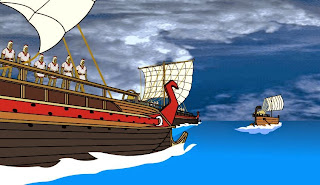
Battle of Mylæ as seen by Look and Learn. Egadi may have been a ramming rather than boarding battle but there were still plenty of deck troops on both sides.
Here reported on Archaeology News Network.
Battle of Mylæ as seen by Look and Learn. Egadi may have been a ramming rather than boarding battle but there were still plenty of deck troops on both sides.
Labels:
ARCHAEOLOGY,
ARMOUR,
CARTHAGINIAN,
EGADI,
HELMET
Sunday, 24 November 2013
'Baal. Help us penetrate this weapon into the belly of the enemy ship.'
Great video summary of Egadi finds.
Remember to set subtext on if you are not good in Italian. More vids in YOUTUBE list. See 'I rostri di Levanzo e la Battaglia delle Egadi' especially - very atmospheric.
Labels:
ARCHAEOLOGY,
ARTEFACT,
EGADI,
PUNIC WARS,
VIDEO
Saturday, 26 October 2013
Sunday, 7 July 2013
Wednesday, 19 June 2013
SUBSTANTIVE EVIDENCE
The rams from the Egadi battle site give a nice confirmation of the violence and effectiveness of ramming tactics. 10 rams from sunken ships (probably Carthaginian triremes) have been found along with helmets from Roman marines.
The amazing thing about the rams is that 4 of the ten show evidence of dramatic use in action.
Ram 3 shown here has evidence of heavy impact against another ship's heavy metal fittings i.e. ram.
That is 2 of 10 rams show damage from ram-ram impact.
Rams 2 and 6 had wood remains trapped in the rams fins - evidence for successful impacts on unprotected wooden hulls.
4 out of 10 ships (that ended their days on the seabed!) had direct evidence of aggressive combat. Quite a monument to the violence of an ancient naval battle. Also supporting the idea that in 241b.c. agile ramming tactics were still practiced rather than a universal slogging match at sea.
Read more at RPMNF website HERE.
Subscribe to:
Posts (Atom)