Showing posts with label SYRACOUSIA. Show all posts

Monday, 6 April 2020

SYRACOUSIA VI : DON'T GIVE UP THE SHIP!


DEFENDING THE SHIP

 There were also eight turrets on it, of a size proportional to the weight of the ship; two at the stern, an equal number at the bow, and the rest amidships. 
To each of these two cranes were made fast, and over them portholes were built, through which stones could be hurled at an enemy sailing underneath. 
Upon each of the turrets were mounted four sturdy men in full armour, and two archers. The whole interior of the turrets was full of Saracen and missiles. 


TURRETS

These turrets have been interpreted as full height towers. This is not necessary. The meaning is a fighting platform. They were not massive - they housed just 4 men and their ammunition. 4 metres square would give ample fighting space plus some racks for amunition.
 
Ship tower a la Ben Hur. Nice, but practical?

A light wall around them would deflect missiles and they could be furnished with machiolation. Sculptures suggest they could be painted to resemble stone-built structure but this is not definite at this early date.

Maybe more like this..fighting platforms not Rapunzel towers
 The 'Saracen'  mentioned here is, I believe, tow-like fibre which can be easily lit. Presumably for making fire missiles.

STONE-DROPPING CRANES

The crane weapons are interesting. They are designed to prevent smaller craft coming alongside - as pirates are wont to do.


The ammunition must be lifted by 2 men by hand so we must assume the calibre was around 1 or 2 talents  25 or 50 pounds, 12 or 25 kilos.(approx.)

Such stones falling 10 metres would have considerable force to crush men or spring planks in a small hull.


The weapon is interesting because it has some parallel with the Theban 'flamethrower' used at the siege of  Delium in  424BC. This was also made of 'beams' hollowed.

There was plenty of ammunition supplied and it would be a brave attacker who came alongside Syrakousia.


MAST-CRANES AND DOLPHINS

 and as there were three masts, from each of them were suspended two large yards bearing stones, from which hooks and leaden weights were let down upon any enemy which might attack the vessel.

Each mast had men serving lines and pulleys which controlled extra yardarms - cranes - which allowed dolphins to be suspended out beyond the ship's sides. Dolphins were an old weapon, used,  not for the first time, at Syracuse in the Peloponnesian Wars.

The principle was similar to the turret cranes, in that a targetted vessel would suffer a heavy weight smashing vertically down into it in free fall. Dolphins could be random heavy things but, in the absence of grand pianos and ton weights the ancients used torpedo or dolphin-shaped lead castings.


ACME is a Greek word, you know? Doesn't lessen the pain though..
 The dolphin was raised to the top of the yard, the yard steered round to hang over the target - probably aimed using a hanging plumb bob - and then released by pulling a pin or slipping a line. Maybe the dolphin could be hauled up for another shot, otherwise it would be cut away and another hoisted.


The same yard crane could deploy an iron hand / grapnel to catch a target and capsize it or hold it for others to attack at will.


 FIGHTING DECK - AN EXTRA DECK OR 1 OF THE 3 ?

A wall with battlements and decks athwart the ship was built on supports;

 Here we read that there was also kind of combat deck on the ship.

This is added to the 3 decks already mentioned. But as we shall see was not a complete deck.

A question arises as to if this was intended to refer to an extra superimposed structure or a specific part of the uppermost deck.

It seems to be an overlying structure because ..

a) the structures on deck 3 needed roofs and this platform could form their roofs.
b) the structure is described as being supported on trestles/tripods  (rather than the columns/pillars of this translation)

The description of a 'wall' crossing the ship is confusing...maybe it refers to the  fore and aft aspects presenting wall-like balustrades? Difficult to interpret.

The platform - which we can call Deck 3A - cannot have extended over the whole of the area of deck 3 because this would cover the promenades, gardens and gymnasium areas which Moschion was so keen to describe.

Deck fighters at this height on the ship  could only hurl missiles or wait to rush to places where attackers had breached the all-round barrior of  iron railings.

Attackers would not need to climb to the top deck. If they got aboard they would be distracted prior to that by the prospect of plundering cabins cargo and passengers while the deck fighters could be left to stew in the sun.
'Chaps, chaps.. I say..there are some steps just over here....

Each mast base needed an area for the mast and tops to be serviced. The large catapult needed a base to operate on and probably to be moved and trained in different directions.

The stables needed roofing. As did the library and reading room - though the roof of this had a circular hole for a sundial. Areas covered by the towers - 8 of them - would not necessarily need a fighting deck at those locations.

The solution would appear to be that there were katastroma-like  strips of decking located at crucial areas over the hull area. Early galleys were not fully decked, they had a narrow gangway down the mid-line connecting forecastle and poop. It is something like this we could see as Deck 3A on Syrakousia.
early undecked pentekonter, later eikosoros with through-gangway

schematic of fighting platform over Syrakousia's top deck
This is a difficult aspect of the reconstruction but we can be sure it was not a true extra deck.

Archimedes' Catapult
on this stood a stone-hurler, which could shoot by its own power a stone weighing one hundred and eighty pounds or a javelin eighteen feet long  This engine was constructed by Archimedes. Either one of these missiles could be hurled six hundred feet.

..this I will save for next time... plenty to deal with besides this....


After this came leather curtains joined together, suspended to thick beams by means of bronze chains. 

Such screens were a common device to block incoming missiles. They were bronze and heavy leather to avoid damage and absorb the energy of the  missiles. They are mentioned in the surviving treatises on siegecarft and artillery but we do not know exactly how they were made. A flexible and heavy hanging mat would catch flying missiles and absorb their force without itself suffering too much.


If you know what I mean....


An iron paling which encircled the ship also protected it against any who attempted to climb aboard; 

I have searched for surviving iron railings from the period or even Roman times without success. Iron is, alas, too -easily recycled for such mundane items to survive the centuries. One might be put in mind of the abbatis-like cervi of Caesar's circumvallation of Alesia whenh considering how these pailings functioned.


Railings could even be put into offensive action if one is so minded. Kubrick shows us how in his spectacle 'Spartacus'.
Some great railing action with Kirk HERE


also grappling-cranes of iron were all about the ship, which, operated by machinery, could lay hold of the enemy's hulls and bring them alongside where they would be exposed to blows.

These smaller versions of the mast-cranes or perhaps even catapult propelled grapnels made it dangerous for small vessels to approach Syrakousia. I have discussed the harpax, which is otherwise assumed to have been devised by Agrippa, Octavian's admiral, centuries later, in a previous post HERE


Sixty sturdy men in full armour mounted guard on each side of the ship, and a number equal to these manned the masts and stone-hurlers. 

This means there were 120 armed deck fighters manning the ship. There were cabins for them somewhere or else they must have sheltered under awnings on the deck or fighting platforms. It is interesting what the passengers made of 120 plus warriors milling around the place.

Jenkins rued the ticket price for his week on the Zambezi river considering the limited privacy the vessel afforded

Also at the masts, on the mast-heads (which were of bronze), men were posted, three on the foremast, two in the maintop and one on the mizzenmast; these were kept supplied by the slaves with stones and missiles carried aloft in wicker baskets to the crow's-nests by means of pulleys.

Syrakousia's 'fighting tops' were not the large, heavily-manned platforms of the 'age of sail'.


But they surely could deal some damage as the men up there were relatively immune from attack and well-supplied with missiles which would have serious effect when thrown from such a lofty perch.


Sluys 1340. Gravity still a potential threat.

DEFENSIVE STRATEGY

Syrakousia seems to have been designed with the idea of primarily keeping attackers at a distance. It would have been extremely dangerous for smaller craft, less than a trieres in size, to approach Syrakousia. This is consistent with the main threat being piractes rather than warships. Pirates operated with vessels that could be used as fishing boats when the owners cupboards were not bare enough to have their wives place a cutlass or grapnel on the dining table one evening.

Small vessels with clusters of desperate men aboard,  appearing form behind headlands were the pirate's mode of attack. Several vessels could cooperate to corner a victim. The denouement was when a wave of badly dressed expert sailors swarmed onto the cornered vessel and waved very sharp agricultural instrument under the noses of the occupants who had not already had a siezure or jumped overboard.
Who is tractoring who ?

To be taken by pirates meant certain slavery, possible ransoming, rape of all denominations and death or mutilation for the uncooperative or unlucky. Not to mention the loss of the cargo and the ship. Hence defence.


Along each side there were 7 crane weapons which could reach out several metres. There were the tractor beams . the grapnel thrower - which could drag unwary attackers close.


There were 60 deck fighters chucking javelins, stones and shooting arrows on each side.

 
Cruel, yet satisfying.

 If the attackers got alongside they had to climb a spiked iron railing under shot and spear-thrust.


Once aboard, the crew of 600 ( ! ? ) would resist. Added-to the occasional sharpened hairpin or aggressive lapdog of the first class passengers this is a lot of manpower.


10 or 20 cutthroats would steer clear of Syrakousia. Several boat-loads of pirates would not bother with Syrakousia. It would take a major combined effort  of several settlements or a state-backed episode of privateering to think about tackling Syrakousia! Unfortunately such shady enterprises were usual along the rugged coasts of the Mediterranean. Hence, Syrakousia was such a bonney girl.
Beautiful lines, full form, comfortable ride, but sharp talons and expensive to maintain : Pirate keep your distance!!!

 Had they but world enough and time no doubt Hieron's brains trust could have devised anything. The only way to secure her cargo better would have been to make Syrakousia a U-boat. Looking at the early models such as Turtle and the Holland, and considering Aristotle's observations about snorkels or breathing lines.....


Just then as divers are sometimes provided with instruments for respiration, through which they can  draw air from above thewater, and thus may remain for a long time under the sea,so  also elephants have been furnished with their lenghened nose wherever they have to traverse the water they lift its tip up above the surface and breathe through it. For the elephant's proboscis as already said, is a nose. 
(Aristotle, de partibus animalium, Part ii.16:658b30 f.)

Probably it was the plans for a u-boat which a Roman soldier stood on as he butchered Archimedes.
Alexander is reputed to have gone down in a diving bell, maybe even with Aristotle, at Tyre. Sadly,  this story has no historical foundation. 
But Syrakousia proves, truth is usually stranger than fiction....
Sunday, 22 March 2020

SYRACOUSIA II

Just what Hieron II wanted with a monster grain freighter requires some explanation.
Why should an hellenistic monarch seek to extol his own and his kingdom's power and virtue by means of a massive maritime corn carrier ? 

South eastern Sicily is fertile. It was also under peaceful control of Hieron. It was a grain basket of the ancient world.  In the mid 3rd century BC there was much money to be made from selling corn abroad or largesse to be shown by giving it away to places with poorer agriculture or smitten by war pestilence or earthquake. If Hieron could safely despatch corn around the Mediterranean there was a fortune to be made.

Hieron made a name for humself by attacking the Mamertines. This was a public service because these were a collection of brigands slaves pirates and freebooter who had settled in the city of Messana. The Mamertines called themselves 'the people of the war god' after Mamers an Oscan war god.The menfolk of Messana were descendents of mercenaries hired by the tyrant Agathokles, himself an infamous  fore-runner of Hieron at Syracuse. They gained the city by murdering the citizens one night and siezing their women and treasure. Their subsequent behaviourtowards the neighbours was no better. Forget ideas about Johnny Depp in big boots and a bandana. Mediterranean pirates of the classical world ranked with the lowest form of humanity to emerge anywhere.

Mamertine warrior c. 220AD - could be Mamer?
Being an island and a colony of Corinth it was vital for Syracuse to keep the sea lanes open. If piratical activity became to intense the island was effectively blockaded. Mamertine and Tyrrhenian pirates harassed Hiero's trade but they were difficult to eradicate.
a pirate galley intercepts a grain freighter : Attic vase c.450BC

So for Hieron moving his grain safely was a big deal.

To move grain safely by sea requires certain things of the transporter.


Size : better to move a lot in 1 go - the hamster foraging  principle.


Speed- do it fast to avoid predators - again a lesson from hamsters. A longer hull gives higher speed .

Stability - bulk cargo is dangerous to move in bad weather. A broad stable hull is better. (Also for wealthy passengers...)

Bulk carrier Stellar Banner after cargo of ore shifted
Defence - pirates could descend in hoards. Any freighter had to be able to defend itself against several other ships and perhaps hundreds of attackers.

Manouverability - this would be limited by the size of the ship but the ability to manoeuvre into harbour was vital,  or to evade pursuers.

Servicability - the hull and rig should be robust and not require anything out of the ordinary to keep it in running order.

All of these factors mitigate for a large ship rather than a small fast one or a flock of small ones.

Galleys were reliably fast and could sail through calm but they had a limited freight capacity in their slim shallow hulls and so the ship should obviously be a sailing ship or 'round ship' 'strongylos'.

THE DIMENSIONS OF THE SHIP

Just how big was this 'monstrous mass' ?

From Athenaeus we get to know the following:
  • it required the wood for 60 triremes to construct the whole thing
  •  the sacred trireme built by Antigonos and victorious off Kos was not a quarter of Syracousia
In addition we can note that
  • the Nemi vessels, the largest found, are 70mx30m and 73m x24m 
  • grain freighter Isis from Lucan's poem 'The Wishes' , 55m by 13.5m or so, hold 4 - 5m deep
  • Caligula's obelisk-transporter was 104m long -  but only made 1 voyage
  • Ptolemy II's '40' could have been about 100 metres long 
  • Ptolemy IV's Thalemagos was 30 cubits by half a stadion i.e c.15m by 90m !!
  • longest wooden ships without steel bracing < 80m WIKI LIST HERE
Largest wooden ship - Wyoming in 1917 - 140m x 15.5m : ships this big had steel hull bracing (still failed)
Taking the wood used first. If we consider the project as a 3 dimensional mass of wood with a similar density of wood involved within the whole structure then 60 times the mass of a trireme from Coates this would be about 30 tonnes of wood.So...30 x 60 = 1800 tonnes.

The trireme occupies circa 35m by 6m by 4 m of space.840m3

840 cubic metres x 60 is 50,400.

If we take the cube root of this we can get the block equivalent of the monster...Yes, very simplified...
 

The cube root is 36.Double the length to half the width and get the profile more elongate.

Interestingly, if we double the length we get about the length of the Nemi ships. And the longest modern era wooden ships.

We must then halve another dimension, shall we use the height, to get an 18m high structure.

This ballpark model is a block 72metres long by 36metres wide and 18metres high.

Very rough, and we should expect more wood goes to strengthening the hull and reducing the interior volume. If we reduce the interior volume by a quarter, conservative, to allow for a heavier structure, we have our block model as 65metres by 32metres by 16metres. Or so.

Now, typically, sailing freighters have a length to breadth ratio around 4:1. As per the Nemi ships which were for use on a confined lake, this falls to 3:1 or less.

VIKING ERA SHIPS ILLUSTRATE THIS WELL

WARSHIPS  L:B RATIO                                   CARGO SHIPS   L:B RATIO
Ladby                   7.4                                         Klåstad                          4.4
Hedeby 1              11.4                                       Skuldelev 6                   4.48
Roskilde 6             9.3                                        Skuldelev 3                   4.24
Skuldelev 5          7                                            Skuldelev 1                   3.44
Sludelev 2            7.5                                         Hedby 3                        3.55

Aslak - Ladby replica and Nidhug( L:B 4)

ANCIENT EXAMPLES
CARGO

Kyrenia Ship   2.5
Isis                   4.5
Nemi 1              3
Nemi 2              3.5
WAR GALLEY
trieres Olympias  7

The same relationship holds.

But our ship must sail the high seas so we must drop the width of 36m down somewhat to a quarter of 65 i.e. 16metres. Following the block model would now mean we stretch the heigh to maintain the timber mass...adding a third or so to the height to give keel to top deck height of 20metres or so.

Mackintosh et al (Syracusia as a giant cargo vessel, IJNA 1999) arrive at dimensions of 61.5metres  length   15.5metres beam  by 10metres high. Not a million miles away.

So we have a length and beam that is useable. I will take 64metres and 16 metres as nice round figures to base my model upon.

The rather top-heavy figure of 20 metres for keel-to-top deck can be controlled by Athenaeus' statements that there were three exterior gangways - parados - plus a hold.  This means 3 decks with ceilings (terrestrial use of the word..) at 2 to 2.5 metres. and a hold of simliar depth would give 10 metres keel to top. Height above water level would therefore be around 7 metres ?

If the topsides were too high then Vasa-Mary Rose syndrome could occur.

Vasa had a poop deck 19 metres above the keel and c.15m above the waterline. In addition, it had a very high centre of gravity. Ancient ships tended to have little superstructure, keeping their centre of gravity low. There was no incentive to have several decks for guns and massively strong superstructure.
 A schooner of similar dimensions from 1920 was c.8m waterline to deck.

A similar sclae vessel for comparison can be provided by the French 118 gun Ocean class warships from c.1800. Larger than the Victory, these were 3-deckers with similar domensions to our prospective Syracousia. at  65.18 metres by 16.25m in beam. They were massive platforms for 118 cannon and survived in service until 1860 or so.
Ocean class 118 gun French warship c. 1800 
These ships stood about 10.5 metres from the waterline to the poop deck.
Their holds were 5 metres deep - most below the waterline.
They had four deck levels above the waterline but these had overheads at under 2 metres each.
These would not be appropriate for the Syracousia which had to accommodate high status guests and had luxurious fittings.

All in all 11 metres over the waterline would seem to be a maximum for a ship of these general proportions.

DIMENSIONS FOR THE MODEL

Erring on a slightly larger 'monstrous mass' I decided to go for the following dimensions.

LENGTH : 64 METRES   BEAM : 16 METRES   HEIGHT ABOVE WATERLINE : 11 METRES


This gives a hull more seaworthy than the Nemi ships, which, although built with the same quality as a sea-going ship are essentially barges not intended to be exposed to waves or swell. or to move under sail. Thus, ot as enormous as the greatest dimensions we know of from the classical world but somehwat according to modern era giants.

The large size of the hull allows stability, higher speed under sail and the carrying of sufficient defences to hold off pirates.

Equivalent of Syrakousia and pirates : 'Standy by to repel boarders!'
 FIGHTING PIRATES : just have to watch again..... HERE  and HERE


Next we will work out the ship's lines.

Tuesday, 17 March 2020

THE HELLENISTIC FLAT TOP

THE most remarkable ship we know about from the ancient world is
 the Syrakousia - the Maid of Syracuse.
 
Syracousia as reconstructed in 1798.

Despite some translations and reconstructions deciding the opposite, Syracousia was a sailing ship and not a galley. Even so,  it is more than worthy of discussion here. She led, for example, a small flotilla of support ships which were mostly galleys.

Flipped Prof is an Italian 3D graphics team(?) who produce reconstructions of the ancient world. They look great but have some errors of detail.

Flipped Prof show here a reconstruction of Syrakousia as a galley with 3 tiers of oars.

Youtube HERE
 

 The error is simply made, because the ancient Greek text is somewhat garbled, technical and difficult to understand if one knows little of ancient ships.

Having held the idea in mind for many years I finally decided that I had to make a model of this behemoth and try to make some sense of the ancient account.

SOURCES

The Syracousia was constructed in a special place and time which allowed for such futuristic, cutting- edge  projects to be carried out.

Hieron the Second of Syracuse was a hellenistic ing who had access to great wealth and great technologists. Hieron started the First Punic War(264BC)  on the Punic side but was obviously gifted in diplomacy for he ended it on the Roman side (241BC) and remained friendly with them until his death in 215BC. As if to demonstrate what a feat this was, within 4 year sof his death the romans had seen fit to sack Syracuse and swallow his kingdom.
Hieron II lived until 92. Barely a bad word written about him (enemies all very dead)
Hieron II was admired and successful and wealthy. Hellenistic kings were supposed to give public displays of their wealth and excellence as a kind of public and religious duty. What would today be seen as wasteful junket would have been interpreted as a demonstration of how the gods smiled on the kingodom's ruler and therefore the kingdom and therefore each individual citizen. Big parades, tours and festivals were de rigeur for an Hellenistic king.

Vulgar to Romans but essential to Hellenistic royalty

 Hieron was fortunate enough to have a bevy of beautiful brains at his disposal. Hellenistic courts loved knowledge, fine arts natural sciences and engineering. Just as his predecessor, Dyonisius I, Hieron patronised the wise and clever. He was lucky enough to have the great Archimedes at the head of his brains trust and this combined with a penchant for shipbuilding led to the Syracousia.

We shall see, Carl, we shall see....
We have an account, a detailed account, (but not wholly clear, dammit!) of the great ship. It comes, bizzarely enough, from a long and rambling work from the 3rd century AD known as 'The Philosopher-Gastronomes'  (Deipnosophistae), by the Egyptian-Greek  Athenaeus of Naucratis. In his work, which survives in incomplete form, Athenaeus manages to name-drop no less than 800 ancient authors and 2500 literary works. He is a mine, (some might say a pile) of information about the ancient world.

Athenaeus, then, scratched an account of a work by Moschion who was an earlier writer. How early we do not know. He could also have been writing AD. But Moschion had knowledge of the Syracousia project and preserved it due to his delightful profession of 'paradoxographer'. His bag was to create the 'wierd tales' or 'stranger than fiction' pulp of his day.
Just now we stick to construction rather than seduction...
Bored with scoffing for a while, the Philosopher-Gastronomes are treated to a lengthy morsel from Moschion which tells of how Archimedes was entrusted with a project to build the biggest and best grain freighter by Hieron II.

But the tall tale told for the delectation of the well-stuffed Hellenestic aesthetes has been a target for scepticism.

THE ENTERTAINMENT PUT ME OFF MY CUSTARD AND LARK-TONGUES...FOR A WHILE..WHY COULDWE NOT JUST HAVE STORIES AND POEMS ABOUT SHIPS INSTEAD ?

Dawe, Diggle and Page, in thier survey of the Greek epigram*,  (p. 27) see the tale as an 'absurd yarn' - as absurd as their Dickensian assemblage of names, no doubt. Part of Moschion's account includes an epigram attributed to one 'Archimelus'.( Incidentally, we know sweet Fanny Adams about these two apart from their naming in Athenaeus.)Epigrams should be pithy, witty, ingenious and brief. They originated as tombstone inscriptions and memorials  - our modern epitaph - where every letter cost money.

(Remember,  'Many archaic epitymbic epigrams are monostichs'  A sentence I have vowed never to remember)


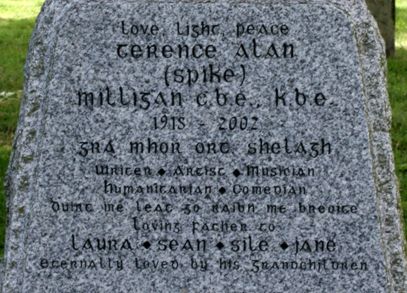
'I told you I was Milligan!'

The problem Dawe, Diggle and Page have with the Syracousia epigram is that it lives up to none of these criteria. Get this.....

Who placed this monstrous mass upon the earth;
What master led it with untiring cables,
How was the deck nail'd to the mighty beams,
And with what axe did men the vessel form?
Surely it equals Aetna in its height,
Or any isle which rises from the sea
Where the Egean wave entwined foams
Amid the Cyclades; on either side
Its breadth is equal, and its walls alike.
Sure 'twas the giants' work, who hoped to reach
By such vast ladder to the heights of heaven.
Its topmast reaches to the stars; and hides
Its mighty bulwarks 'mid the endless clouds.
It holds its anchors with untiring cables,
Like those with which proud Xerxes bound the strait
Which between Sestos and Abydos foams.
A deftly carved inscription on the side
Shows what strong hand has launch'd it on the deep;
It says that Hiero, Hierocles' son,
The king of Sicily, pride of Dorian race,
Sends it a wealthy messenger of gifts
To the Aegean islands; and the God
Who rules the sea, great Neptune, convoys it
Safe o'er the blue and foaming waves to Greece.

You may notice that the 'epigram' is almost as large as the monster ship herself, but we must remember tha the form did get extended with time to allow flowery praises to be heaped on the subjects.
The judgement of DD&P is that this epigram is 'the most fatuous to have survived from the Alexandrian era'. Also . 'the hyperbole is grotesque'. Academics stamping their feet are never a pretty sight. DD&P conclude that the whole tale is a fanciful crock and dismiss it.

Unfortunately for the poetry-inclined latter-day dodgy legal firm, they were not naval architects nor were they sailors. Like Livy they write about nautical themes from the security of their bathtubs where the most complex vessel in sight is a plastic duck.

Now we can explain the most complex ancient ship ..Oh I can anyway because  I built it.....
 DD&P used a naval expert upon which to base their judgement. The one they chose was the intrepid, and impressive Cecil Torr. I will devote a whole blog page to Cecil Torr. He is one of my favourite writers and researchers on classical war galleys and ancient nautical topics in general, not to mention ancient Greek music.  To an Englishman he also has to his credit the publication of one of the most profoundly English books ever. Ranking with Tristram Shandy. But that was nothing to do with Syracousia. The point about Cecil Torr is that he is rather dead. Even in 1981 when DD&P published their tome he was long gone.Cecil's feet failed to retain their wooden enfurbishments in 1928.  Torr's classic  ' Ancient Ships' was published in 1894. DD&P missed out on almost a hundred years of research, discovery and debate and the birth of maritime archaeology. They dismiss Syracousia as an absurd yarn on the basis of an earlier generation's knowledge of ancient shipping.  Apart from that, they were probably correct about the poem's artistic merits....

The facts that we have from Moschion via Athenaeus are fabulous but can be shown to lie within the technical capabilities of the classical world.

The Nemi ships, Caligula's pleasure barges proved such colossi were constructed by the ancients. (may the German army be ever cursed for burning them!). Accounts of the Ptolemies' massive Nile-cuisers - Thalamegoi - back the concept up. Many authors have pored over the after dinner tale - probbly often after dinner - and worked out that Syracousia lies well within the realm of capability for men of the calibre of Archimedes. 

Queus to see ships excavted at Nemi in 1932
Caligula's pleasure-ships : 70 and 73 metres long. with beam 30 and 24 metres

I wanted to build a model of this thing and now I will lay out how I proceeded in the following blog entries.


HELLENISTIC FLAT TOP ?

If the Hellenistic world had aeroplanes they could have landed on this thing ! With the ingenuity of the modern era's early naval fliers a seaplane using a combination ofI Icarus' wings (with perfected non-melting glue!) Heron's jet engine, the torsion devices invented for artillery etc. could have allowed a microlite type thingy to have been produced and operated from a Syracousia type vessel, more than 50 metres long and with a flat top.
HUMAN FLIERS HERE
 Just a crazy thought which I will not pursue further ! ;)

(The silver lining in the cloud of Covid19 is that I have time for this ....  More follows...)


 *Further Greek Epigrams. Cambridge 1981