Take a tour of ancient Miletus - an important naval base for the Achaemenians - at the site of the Hellenic Foundation for History and Culture.Tour starts with a trip on a trireme ;)
Naval Warfare with Ancient Galleys : Card model ships, wargame rules and the background for their development : All original material copyright
Sunday, 28 September 2014
A WALK IN MILETUS
Take a tour of ancient Miletus - an important naval base for the Achaemenians - at the site of the Hellenic Foundation for History and Culture.Tour starts with a trip on a trireme ;)
Labels:
ARCHAEOLOGY,
BUILDINGS,
DIGITAL RECONSTRUCTION,
FILM,
HARBOUR,
MILETUS,
RECONSTRUCTION
Saturday, 27 September 2014
CORINTHIAN MODIFICATION : AGAIN
The 'Corinthian Modification' continues to intrigue me. Thucydides(Book 7.) gives a semi-technical explanation of how the Corinthians achieved a 'draw' against the superior seamanship of the Athenians at an engagement off Naupactus led by Polyanthes. They had the 'prows' of their ships built-out 'wider', or 'thicker/stouter'. This allowed the Corinthians to ram their opponents head-on without fear of damagiung themselves. The Athenian ships were damaged at the epotides - the cross-beams which braced the front of the ship and supported the parexereisea - the outriggers which the thranites supported their oars on. Dismounting the outrigger on opne side would knock out 1/6 of the trieres' oar power - 1/3 if the others had to stop rowing to balance the ship's progress. Translators usually have a bit of trouble with the technical terms for parts of the ship but looking at the Greek can help sort out if they are out to lunch or just confused.
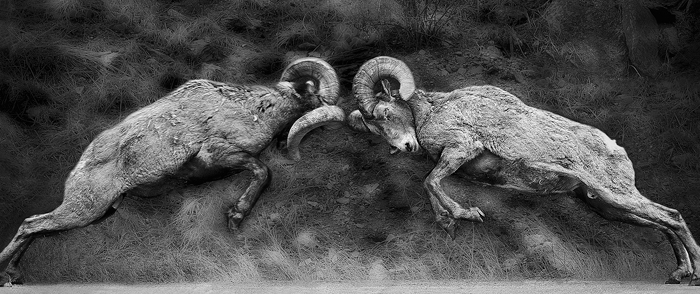
| Head-to-Head Ramming |
Diodoros
Sikeliotes had to hand various authors who had previously written about
the Peleponnesian War and he had his local reasons for going into the
subject of the Sicilian Expedition in some detail. To this end we can
find the Corinthian Modification turning up again in the battle in the
Great Harbour. (Book XIII Ch.10). The instigator of the Sicilians
modifying their ships is the leading Corinthian kybernetes, Ariston -
according to Diodoros. Thucydides also writes of Ariston but does not
mention him as an instigator of the modification of the ships.
Diodoros explains the modification in some detail but seems rather confused. He describes the Athenian form of trieres as being weakly designed and too high at the prow. So high that they are designed to ram the target above the waterline. In Diodoros view the Corinthian Modification involves making the ship's prow shorter, lower and stronger.
DS seems to have his wires crossed, for various reasons, but in examining what he writes it gives us some insights into the actual form of the Corinthian Modification, which supports Thucydides succinct account.
I think Mr Sikeliotes did not know much about combat with trieres but had some sources who did.
He uses the term 'brakuteras' of the Corinthian ships prows. Thucydides says the ships of the Corinthians had their prows shortened συντέμνω cut down, cut short. In this case, the term means more of a cutting-across or reducing in length rather than reducing in height. When we look at the word for the ship part concerned also, this is proros - the prow. Proros is the prow - the front of the bow, not the 'top' of the bow. The high horn commonly seen at the bows of a trieres has no stuctural function. Brakuteras means short in stature rather than length. Maybe DS did not understand what his source had written. He knew ships had a bow and often a focsle at the bow. Still, at his time, the first century BC, warships had a horn on the prow - though more often now a volute.
If the ship's prow is long then the chance of the strengthened epotides coming into contact with another ship's epotis are less. Taking the ram housing away, for example would dramatically shorten the bow. The stem-post is still there and the epotides can be braced together with beams as Thucydides describes.
We could even speculate that the 'normal' trieres at this time did not even have any bracing for the epotis because they determinedly were not supposed to be hit head-on except by loonies. The fact that the Corinthians dared to contemplate this was their stroke of inspiration/desperation/genius. If the nose of the modified trieres can miss the ram of the opponent then it can smash its monster reinforced stempost into the epotis of the opponent. If up until then there had been no call for a reinforced epotis then it would be even more vulnerable than that on Olympias and could be smashed/dismounted.
Anyway, that was some more ramblings about galleys... The last intersting thing about the Corinthian Modification is that it seems only to have been used in two locations, both with restricted waters. Chpping the cut-water off a long galley and piling a load more timber in the bow would not do a lot for its hydrodynamics. The ship would be slower, more prone to resistance from headwinds or waves and thus not perform well as a strategic weapon. The point about trieres was that they were reliably fast over long distances. Patrolling a gulf or fighting in a harbour avoided such considerations. When we hear of Sicilian trieres fighting around the Hellespont in the later war no mention is made of any special capabilities for them. Having to sail to from Sicily and work in concert with other Peleponnesian squadrons would preclude the use of the Corinthian modification.
Labels:
CORINTHIAN,
DIODOROS SIKELIOTES,
THUCYDIDES,
TRIERES
Monday, 22 September 2014
RULES TESTING AGAIN...
Athenians entering battle area with Peloponnesians heaving into view.
Peloponnesian left enter and turn to round the Athenian-friendly shore. More Peloponnesians in the distance.
View from Athenian territory. Peloponnesians advancing in file.
A solution to clutter. Command boards and cards kept on book-rests above the table.
Sunday, 21 September 2014
DIEKMINUS
Before accepting commonly regurgitated explanations of things we do not completely understand from ancient scources...think.
Monday, 15 September 2014
ERMENT 1.1 NOW IN COLOUR...
To celebrate 30,000 hits here is the Erment ship with colour.
The paint is different oxides. Unglazed. The deck troops will have bronze spears and the kybernetes some tillers.
This is a first attempt and I will make a full-size one soon.
A few oars did not survive firing and my handling.
The colours are bit scary but, as with ancient sculpture, a lot of the keramik items were originally gaudily painted. The B model will get a coat of terra sigillata before painting to make the colours even brighter!
The paint is different oxides. Unglazed. The deck troops will have bronze spears and the kybernetes some tillers.
This is a first attempt and I will make a full-size one soon.
A few oars did not survive firing and my handling.
The colours are bit scary but, as with ancient sculpture, a lot of the keramik items were originally gaudily painted. The B model will get a coat of terra sigillata before painting to make the colours even brighter!
Sunday, 7 September 2014
Figuring Things Out
Ship games need figures of some sort. To represent the deck troops and any actions on land associated with a battle.
With 1/1200 and 1/600 ships troops get very small indeed. '2mm' scale may be useable with them but any visible details are completely lost and the space to manipulate them is miniscule.
My solution for troops has been card/paper printed elements which are cheap and easy to use.
I just purchased some Heroics and Ros figures for the first time in many years to see how they sat with the card models. The other main suppliers are Bacchus, Irregular and Rapier at this scale.
There is a lot of discussion about scales and as far as I can see the problem of 'scale creep' is a function of frustrated sculptors who increase figure size to enable them to add detail. 20mm in plastic became 25mm in lead and 25 mm has increased to 28mm. The production process in plastic often involves a size reduction from the original to the production items and so the human proportions and fine detail of Preiser and Zvezda are jealously sought after by leadsmiths - resulting in scale creep.
If we take 5'8" as a warrior's height - as per Vegetius - this gives us c.1727mm.
Some scales for figures are quoted as 'eye-height' or foot-to-eye. 1727 is to the top of the head. On my measurement the Iranian spearmen from HR are 6,5mm sole-to-crown. This is very hard to photograph due to parallax.
6,5mm into 1727 gives 266. i.e. a 5'8" man 6,5mm high is thereby modelled at 1/266 scale. Close to 1/300 but no cigar.
Playing a little we can see that 1727 / 300 gives 5.76 as the sole-crown scale height for an ideal 1/300 miniature.
If our ancient man is 5cm shorter - at 5'6" /1677mm- this gives a model scale of 1/258 ..getting bigger.
What this means is that larger figures such as Bacchus are getting further away from 1/300.
Now, for ships. Eric Hotz's ships are, nominally, 1/300 scale. Examining some models we can see that they are a little over-sized. A trireme is about 170mm long - to represent Olympias' length of 37m. This gives them a scale of 1/217. Nowhere near 1/300.
Putting Heroics and Ros figures on their decks shows this disparity. The HR figures are lost.
This goes some way to explain why Bacchus figures look better than HR on RomanSeas ships.
At present I want to produce my ships at a scale where a trireme is c.10cm long. The aim is to have a scale where what happens on deck can be shown whilst giving a playing area as large as possible.
10cm representing 37m gives a scale of 1/370. There is obviously an overshoot here aswell but I was not actually aiming for 1/300.
If I put HR figures on one of my triremes they do not look like dwarves but they do not look like giants either...
RRW ships have a scale discrepancy of -23%. RomanSeas have a discrepancy of +28% relative to 1/300. RRW are actually a little closer to HR figures scale. Bacchus' larger figures sit better with RomanSeas than with RRW.
Looking at some fotos of Olympias I can be happy that HR will actually not look out of place on RRW ships.
With 1/1200 and 1/600 ships troops get very small indeed. '2mm' scale may be useable with them but any visible details are completely lost and the space to manipulate them is miniscule.
My solution for troops has been card/paper printed elements which are cheap and easy to use.
I just purchased some Heroics and Ros figures for the first time in many years to see how they sat with the card models. The other main suppliers are Bacchus, Irregular and Rapier at this scale.
There is a lot of discussion about scales and as far as I can see the problem of 'scale creep' is a function of frustrated sculptors who increase figure size to enable them to add detail. 20mm in plastic became 25mm in lead and 25 mm has increased to 28mm. The production process in plastic often involves a size reduction from the original to the production items and so the human proportions and fine detail of Preiser and Zvezda are jealously sought after by leadsmiths - resulting in scale creep.
If we take 5'8" as a warrior's height - as per Vegetius - this gives us c.1727mm.
Some scales for figures are quoted as 'eye-height' or foot-to-eye. 1727 is to the top of the head. On my measurement the Iranian spearmen from HR are 6,5mm sole-to-crown. This is very hard to photograph due to parallax.
6,5mm into 1727 gives 266. i.e. a 5'8" man 6,5mm high is thereby modelled at 1/266 scale. Close to 1/300 but no cigar.
Playing a little we can see that 1727 / 300 gives 5.76 as the sole-crown scale height for an ideal 1/300 miniature.
If our ancient man is 5cm shorter - at 5'6" /1677mm- this gives a model scale of 1/258 ..getting bigger.
What this means is that larger figures such as Bacchus are getting further away from 1/300.
Now, for ships. Eric Hotz's ships are, nominally, 1/300 scale. Examining some models we can see that they are a little over-sized. A trireme is about 170mm long - to represent Olympias' length of 37m. This gives them a scale of 1/217. Nowhere near 1/300.
Putting Heroics and Ros figures on their decks shows this disparity. The HR figures are lost.
This goes some way to explain why Bacchus figures look better than HR on RomanSeas ships.
At present I want to produce my ships at a scale where a trireme is c.10cm long. The aim is to have a scale where what happens on deck can be shown whilst giving a playing area as large as possible.
10cm representing 37m gives a scale of 1/370. There is obviously an overshoot here aswell but I was not actually aiming for 1/300.
If I put HR figures on one of my triremes they do not look like dwarves but they do not look like giants either...
RRW ships have a scale discrepancy of -23%. RomanSeas have a discrepancy of +28% relative to 1/300. RRW are actually a little closer to HR figures scale. Bacchus' larger figures sit better with RomanSeas than with RRW.
Looking at some fotos of Olympias I can be happy that HR will actually not look out of place on RRW ships.
Labels:
BACCHUS,
HEROICS AND ROS,
HOTZ,
IRREGULAR MINIATURES,
SCALES,
WARGAME FIGURES
KERAMIK
The Erment project got my fingers itching to do some other relevant items.
Now I have my own versions of the Lenormant relief...
The Abruzzo relief...
And the image from the grave stele of Demetrias, an epibates who died c.370bc...
Demetrias will have a bronze spear in his hand.
In addition, I made 1/6 scale model of the Egadi 2 ram. Probably off a light 3 or a 2.
Should I bother to make all 11 ?
Now I have my own versions of the Lenormant relief...
The Abruzzo relief...
And the image from the grave stele of Demetrias, an epibates who died c.370bc...
Demetrias will have a bronze spear in his hand.
In addition, I made 1/6 scale model of the Egadi 2 ram. Probably off a light 3 or a 2.
Should I bother to make all 11 ?
Subscribe to:
Posts (Atom)