Rafaelle D'Amato has been kind enoug to write with some rebuttals to my criticisms of the last two Osprey ancient warship books. I am ignorant of many things, apparently, and am no Harvard scholar.
I will not flood the blog with the twelve pages or so of wordery in one go but I'll put them up with any further comment over the next month or so and find some graphical stuff to illustrate them.
Meanwhile the new Roman Imperial Warship title should be out soon, so that will also be interesting to see.
A nice galley picture to finish....
Here we can see Caesar's ship - apparently a Four ? getting swamped, as he and his men flee from the Alexandrian counter-attack on the Heptastadion in 48-7BC.
This is a nice illustration from the Dorling Kindersley book on Julius Caesar. The illustrator is also the author, Richard Platt (see HERE). He is a fantastic artist, producing highly detailed and complex panoramic scenes with hundreds of figures. He also does books with cross-sections of ships, buildings etc.
At the moment you can get his book (used) for 1 penny !!! on Amazon UK -plus postage. Maybe not the last word in academic judgement on J.C. but interesting and lively to read anyway. The best thing is just spending time to scan the complex pictures - it would be great to do with a child or grandchild and spark their interest in the ancient world. Or just keep it for yourself....
Conan the Barbarian (not the comics, peasant!) was a staple of my teenage years alongside Sven Hazel and Pan Horror books.
A WORLD OF IMAGINATION AND HISTORICAL ALLUSIONS
The Conan books are so vivid partly because they are inspired by real historical material repurposed for sword and scorcery. A world with a map and all its population of different tribes, religions and fabulous cities. If you grow up, eventually, you realise the true history of the world is far wierder and more wonderful than any fantasy - just read Herodotos - and eventually you will come to realise the most exotic themes come together around ancient galleys !
When I began wargaming one aspect was modern naval wargaming with 1/3000 scale models. It was easy to make a battlefield and you did not need many pieces. The downside was the game was boring, usually. At that time it was mostly a lot of dice throwing and using many charts to work out your boiler had a small leak. In recent years I found out about a craze that swept the U.S. during the war years for multiplayer naval wargaming which included both men and women playing in ball-rooms !
These games used a set of rules devised by one Murray Fletcher-Pratt. The game was mathematical but also fun enough to get people playing it on unused ball-room floors. Fletcher Pratt was keen on all things naval and produced the following impresive list of publications !!!
The Compact History of the United States Navy (1957)
OCLC 367782
Empire and the Sea (1946) with Inga Stephens
Fighting Ships of the U.S. Navy (1941) illustrated by Jack
Coggins
Fleet Against Japan (1946)
The Navy has Wings; the United States Naval Aviation (1943)
The Navy, a History; the Story of a Service in Action
(1938)
The Navy's War (1944)
Night Work: the Story of Task force 39 (1946) OCLC 1492544
Preble's Boys; Commodore Preble and the Birth of American
Sea Power (1950) LCCN 50-10765
Sea Power and Today's War (1939) OCLC 1450484
Ships, Men - and Bases (1941) with Frank Knox
A Short History of the Army and Navy (1944)
Unfortunately, Fletcher Pratt did not turn his attention to ancient naval matters, but he did start a writers guild, the 'Trapdoor Spiders' in 1944, who produced all kinds of fiction, originally as a way of escaping their wives for a short time! The members of the Trapdoor Spiders were an erudite bunch indeed, Isaac Asimov, Theodore Sturgeon to name but two.
Sturgeon, Asimov, Carter AND !!!!!! Lionel Casson !!!
Amazingly enough the late, great Lionel Casson was also a member. If you are a galley fan you will know who he is.
Lin Carter produced some Conan stories as a 'posthumous' collaboration with Howard Carter by finishing some Hyperboria stories. He did this in collaboration with another Trapdoor Spider, L.Sprague de Camp. This name I knew originally from the covers of paperbacks about Conan.
Carter and Sprague de Camp were greatly interested in historical themes as well as writing. They collaborated well in completing and extending Robert Howard's oeuvre.
When I started writing this piece I was soon reminded of the Six Degrees of Bacon type game. It is so wierd that so much of what I have been interested in through life is linked together in wierd and wonderful ways. But, again, human brains are machines for pattern recognition and just like the same favourite thing you own turns up in your new girlfriend's apartment does not mean you were meant to be together! Educated middle class writer guys in 40's New York had to meet somewhere....
Anyhow, it is great to feel Conan set me up for sailing on wooden ships and being a galley fan in later life. Onward...
Sprague de Camp was just as polymath and interesting as the other Trapdoor Spiders. He was a scientist, working in aeronautical engineering, but also interested in history. Galleys are ancient technology and so it was inevitable that he should eventually focus his attention on our favourite topic. He wrote popular science books such as explanations of evolution and energy and power.
One of the most memorable titles is 'Rubber Dinosaurs and Wooden Elephants - a collection of mind boggling essays that jump over a plethora of subjects which reminds me of James Burke's 'Connections' series but more entertaining.
More directly, getting down to galleys, my first contact with Sprague de Camp's ancient history fiction was a book I did not realise was by the same bloke writing Conan stuff. This was 'The Bronze God of Rhodes' . This is a great read with a lot of ancient history and technology in a 'rip-roaring' tale. One cannot take these books too seriously but they are atmospheric and entertaining as well as including informative factual material. Indeed, the eccentric symposium members in this book are said to have been modelled on the Trapdoor Spiders ! (who is who ?).
I did not realise until recently how many of this genre Sprague de Camp produced. They are a real mine of information and ideas - some now outdated - but always entertaining.
These books are a great antidote to getting bored slogging through factual material. The can give your interest a reviving kick and if a gamer then provide nice ideas for situations and scenarios.
The Arrows of Hercules is about inventing catapults in Dionysian Sicily.
The Golden wind is the real sailing one ! About navigating to India and back !
The Elephant for Aristotle is about transporting an elephant from Alexander in India to Athens!
Along with the fiction there is also some great reading about ancient technology. Some now a little dated but Sprague de Camp was such an entertaining writer they are still worth a go.
So, maybe I was doomed from early on to end up interested in ancient galleys. The trail from Conan to pentekonter was inevitable. But following that trail backwards is also interesting when it hits on such a crazy and fertile set of collaborations.
Sprague de Camp, Heinlein and Asimov !
Even better combination...guys girls and galleys (almost never seen in reality)
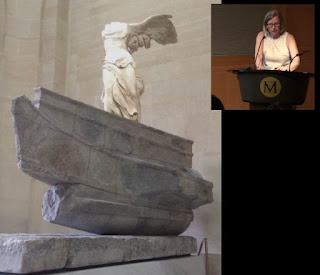
The Samothrace Nike is one of the most famous statues in the world. It should follow that the ship - an ancient war galley ! - she stands on should also be famous. Sadly, the ship is often forgotten and does not feature in many printed photos of the monument. galley fans don't forget the ship, though, and last year an interesting paper was published concerning it.
The Monument
The Samothrace Nike stood in a fantastic location before it was probably destroyed in an earthquake and plundered for building stone. The remnants were identified as something interesting and taken to the Louvre by three expeditions in 1863 , 79 and 81.
Nike being protected from war in 1939
The viewer saw the ships standing in a pool of springwater.
The blocks were put back together to reveal the remains of a beautiful statue standing on the prow of a ship. The monument was constructed between 220 and 185BC and is thought to be a memorial for one of the sea battles that Rhodes participated in against Philip V or Antiochous III.
The Statue
The Nike - goddess of victory - is standing on a victorious warship and proferring a victory garland. The sculpting is second only to the Parthenon frieze and the artist may have gone on to work on the Pergamum Altar frieze now in Berlin. The wings were additions, fitted into slots and cantilevered out over the shoulders, secured with pins. The figure was originally painted.
Traces of colour...
Beautiful short film on Nike's discovery and recovery and restoration.
The Nike was not just a pretty face, though. She was located at a crucial point to provide stability to the monument. The ram and stem actually stood proud of the base and gave an even more realistic appearance with the water running in beneath the ship! In order for the sculpted blocks to stand in this way the statue is positioned exactly and her mass counters the ship's prow perfectly.
Blue blocks are secured by Nike. No Nike - no monument....
The Ship
17 blocks form the ship and it stands on a base of 6 flat blocks. The ship and figure are of white Parian marble and the base of grey Rhodian marble. The scale of the sculpture is about 66% of the original size. This is calculated from the length of a rowing 'room' or interscalmium from the spacing of the oarports. The most remarkable thing about the ship is how fine-lined it is. A slim profile of an efficient bow for mounting a ram and cutting through the water. Originally visitors would have experienced the ship as gliding towards them over the water of the fountain pool.
Bronze reconstruction 1890's
Identifying the Ship
The type of ship depicted has been a bone of contention. It has variously been described as a Three, a Four, a 'lembus biremis' or a Trihemiolia.
Last year a paper was published (HERE - 12dollar download) identifying the ship as a Four.
The recent conservation and reinstallation of the Nike of Samothrace,
the restudy of its archaeological context and petrology, the collapse of
the consensus that it celebrated the Rhodian naval victories at Side
and Myonessos in 190 B.C.E., and the growing accord among naval
historians that its ship is not a trihēmiolia together prompt a
reexamination of its date and purpose. Fortunately, the monument offers
three significant clues, all previously overlooked or underappreciated.
First, why was it dedicated on the remote island of Samothrace, and
not, for example, on independent Delos? Second, although ancient galleys
could not fight in gales and never did, why is it battling one? And
third, why is its ship made of imported Rhodian marble and probably a
quadrireme, a vessel superseded elsewhere by the quinquereme but still
favored by the Rhodians? The Great Gods’ rescue of pious initiates from
storms at sea and second-century B.C.E. naval history point to one
occasion in particular: Prousias II of Bithynia’s abortive invasion of
Pergamon in 155, his impious assaults on the sanctuaries en route, his
fleet’s sudden destruction by a storm, and the Rhodian contribution of
five quadriremes to Attalos II’s successful naval counteroffensive in
154.
The grounds for this were based upon the fact that a Four is a cataphract ship. This means its hull was closed-in so it could fight at close quarters with the rowers protected from missiles. The author''s sole peg for his identification was the 'fact' that the Nike was standing on the deck of the ship. He reasons that because the other types were aphract ships with no deck then the Nike could not be standing on a deck that was not there.
A cataphract ship : sides closed and fully decked-over (where troops stand)
Unfortunately, when one looks at how the Nike has been standing for 80 years or so, and how she stands today, one can see she is standing on a deck which is not there. The blocks of the blocks of the monument were carefully made to include a gangway - or not. The Nike was until recently standing on a block over a gangway and now stands on one set in the gangway. There is also the clue that she has wings and does not even need a deck to stand on !
The gangway with Nike set over it.
If only one could always see round the sides or back of museum exhibits ! If there was a perfectly made block missing then there is no gangway. There is no detail engraved on the top of the blocks, maybe because the viewer could never see downward onto it.
Filling the gap - fragments left behind on Samothrake maybe.
If the Nike is not standing on a Four then the rest of the arguments become weaker. The campaign against Bithynia was not a particularly high point in Rhodian history. Be that as it may Stewart's theory has one less place to stand on if there was a gangway or if the gangway was never represented.
Even if there is no gangway, the Nike is standing on the foredeck which would be present regardless whether the rest of the ship was decked-over or not. The foredeck does not allow one to identify if the ship was cataphract or not.
The ram is also a factor to consider. The Athlit ram is a proabbale surviving ram from a Four. It is much heavier and larger than the rams found at the Ægetes Islands which are from ships approximating to Threes or Trihemioliai. The reconstructed appropriate size for a ram on the Samothrace ship is that of a Three/Trihemiolia.
The issue falls back to a basic argument about how far stone monuments copy a real prototype. The unfortunate answer is that they do..but.. If a lot of work is required for a part never to be seen was that work done ? Again, the answer is ..sometimes.... In addition, we have the practice of painting detail onto statues. Morrison and Coates reckon there was painted detail along the sides of the hull above the oarbox to represent ventilation louvres for the oarsmen's benefit. This would argue for a cataphract ship. The renovation found no traces if the paint ever was there. In any case, the Trihemiolia was usually a closed-cataphract ship.
The Samothrace Ship as a Trihemiolia
The identification of the ship as a Trihemiolia is made on several grounds.
1)The monument is probably Rhodian and the Trihemiolia was closely identified with that state.
2)The ship shown has extremely fine lines. Larger ships were broader.
3)There are two sets of offset oarports in the oarbox. A Trihemiolia had a partial third, lower, thalamian row of ports but these would not be visible at the prow.
Trihemiolia after John Coates..................................................................Samothrace prow
The Trihemiolia was an economical ship which was very fast and handy and used by the Rhodians to patrol and police the sea lanes they earned their living from. Thier ships were out-stationed to smaller islands who could not defend themselves against pirate flotillas in a practice known as phylake which was an acknowledgement of responsibility to defend the common good (and your own trade).
HERE YOU CAN SEE THE WHOLE THING (with a godawful backing track)
Nice long documentary mais malheureusement seulement en Francais HERE
If you have not seen enough Nike then look HERE for a lot of video material
Nike at the Louvre HERE




 Sprague de Camp was just as polymath and interesting as the other Trapdoor Spiders. He was a scientist, working in aeronautical engineering, but also interested in history. Galleys are ancient technology and so it was inevitable that he should eventually focus his attention on our favourite topic. He wrote popular science books such as explanations of evolution and energy and power.
 More directly, getting down to galleys, my first contact with Sprague de Camp's ancient history fiction was a book I did not realise was by the same bloke writing Conan stuff. This was 'The Bronze God of Rhodes' . This is a great read with a lot of ancient history and technology in a 'rip-roaring' tale. One cannot take these books too seriously but they are atmospheric and entertaining as well as including informative factual material. Indeed, the eccentric symposium members in this book are said to have been modelled on the Trapdoor Spiders ! (who is who ?).


