Thursday, 7 May 2020

SALAMIS SHIPS IN THE DOCKYARD 2

I got round to casting off some of my Salamis 1/1000 triereis.

1/3600 fortification and 4 frech triereis
 
They are quite satisfactory with no high tech equipment necessary - just 21st century chemistry!
 
No bubbles to speak of, nice detail.

Now I will make another 6 prototypes and mould them so I can cast 10 at a time....

Umber wash to see better...

 If this is too time-consuming or expensive I will switch to glue-gun glue or  air-drying clay.

It will take about a day to cast 100 of these...allowing time for coffee and other things... 


Friday, 1 May 2020

THE ODYSSEY / ODDITY ?

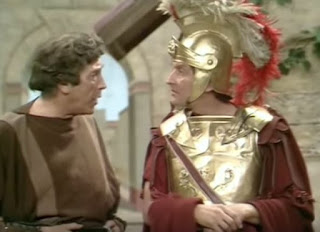
Lurcio is impressed to fight Boadicea in his native land.But the trip is no fun..

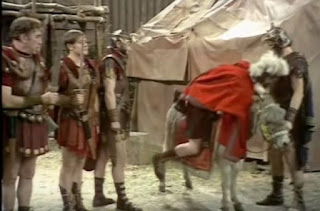
Trojan Cow, early display by Ermine Street Guard, pointless jokes(you have to see it..)

https://www.youtube.com/watch?v=TCu-m83K0OY
Click pic to watch

Tuesday, 28 April 2020

SALAMIS . What scale for a refight?

Considering how to best do a refight of Salamis in the year the Greeks have chosen to celebrate as the 2500th anniversary I intend to to a refight with 1 model for 1 ship.

A basic question is what scale? 'Normal' waterline models come in at 1200th or 600th scale withthe diminutive 3600th scale also available.  I decided to resist the temptation to use 1/72 Academy, Atlantic or Zvezda ships....

The area of the battlefield is an important consideration because your wife will probably resist any intention to knock the living room and dining room into one because of something which happened so long ago. (Was it Tony Bath who had to reinforce his ceiling because he put an enormous sand-table in the loft? Ed.)

Your dining room/gaming table/garage floor is here..

Deciding what scale to fight the battle I drew up a table of values for comparison between the scales.

The total number of ships engaged can range from 600 to 1800 depending on what you want to recreate. In any event it means 500 or so models.


The 'bottom line' is where considerations of space and cost led me. Covid19 has put the kaibosh on any use of the local hall. So a smaller scale and cheaper figures are needed.

I have made some trials with 1200 and 1000 scale models mainly to use a scale where the ships are individual models rather than counters. I like Outpost 1/3600  See HERE and in header photo - but  I will try to do the project in as large a scale as possible.

Trying out some 1/1200 rules for unit-scale gaming...


With beginnings of 1/1200 models in high density polystyrene


1/1000 model prototypes under way.

Fiddly bits
Not bad when assembled. Greeks on left, Barbarians with depth charges ready for Greek sponge fishermen attacks


1/1000 scale models set for moulding - to be cast in resin.

I have a reserve option, to cast the ships using glue-gun glue but I will see how good they look in resin first and calculate the price.

Monday, 27 April 2020

CARTHGINIAN HELMET FROM EGADI

I found another photo of this helmet,  now cleaned.

Archaeologica Viva XXXV N.177
I was hoping the gunge might be hiding something exotic but it would appear this is a pilos type helmet. Though the brim is quite wide and there may be some details we cannot see and the magazine article does not mention.

The Roman poet Silius ( yes , it's true! he was a relative of Biggus maybe ? Ed.) Italicus tells us that a Carthaginian could wear a masked helmet with cheek pieces in his epic poem Punica.
The Roman champion  Asilus meets the Carthaginian Berytas in battle..
 

...while fighting in the centre of the fray, he came upon
Beryas, who had been sent by the Carthaginians to
make a treaty with the king of Syracuse and was
fighting side by side with the Syracusans ; but his
face was concealed by the brazen helmet that he
wore.
Asilus attacked him with the steel, and,
as he tottered feebly backwards, hurled him to
the ground. Then, when he heard his conqueror's
voice, the poor wretch, recalling his life as it were
from Hades in fear and trembling, tore from his chin
the straps that bound his useless helmet
, and asked
for mercy at the same time. He was about to say
more, when the Tuscan, startled by the sudden sight
of that familiar face, withdrew his sword and thus
addressed his antagonist, ere he could speak, with
sighs and tears : " Sue not, I pray, to me for hfe
with doubts and entreaties. For me it is right to
save my enemy. The noble warrior is he, whose first
and last thought is to keep faith even in time of war.
You began it and saved me from death before I saved
you. I should deserve the troubles I have met, and
should deserve to meet again with worse troubles, if
my right hand failed to clear a path for you through
fire and sword." With these words he raised Beryas
willingly from the ground and granted a life
in exchange for the life he had received. 

Well we must make do with the only Carthaginian helmet found on a maritime battle site....

The pilos helmets derived from a heavy felt cap - the pilos/pileus - which was worn as head protection in battle also - being light but capable of stopping all but the most direct blows. In the Sfakteria campaign the Spartans were not best pleased that arrows pierced their piloi easily.
HARDWEAR warrior from Pella , northern Greece 300BC (Livius.org)
SOFTWEAR : Louvre pot - Bill or Ben ?

 There is a chance another of these brimmed styles is represented....


sketches from HERE
The brim is quite broad and flared like this luxury example.
random on ewb----
Anyway, before I disappear down the rabbit hole that is helmet typology ..I did find that some of these deceptively simple helmets can have cheek guards and neck-guard attached.
This fine example resides in Australia!

Nicholson Museum Helmet:
This was probably made in southern Italy in the fourth century BC . Close to our date and place..

(Robinson, E. G. D. 1995. "South Italian Bronze Armour." In Classical Art in the Nicholson Museum, Sydney, edited by Cambitoglou, A. and Robinson, E. G. D., 145-66. Mainz)

Anyway  what might come up from the seabed in the next few years ?????

Look at it--thousands of shields helmets, armour, spears, daggers, belts... if just 1% survives!

Friday, 24 April 2020

Silius Hilarius Pompeius

If you are of a certain age you might remember being forbidden to watch this on TV.
Farce at its best with Frankie Howerd at his peak.

The one with the Ludus Pororum Club (and Roman submarine). Click pic for link.

https://www.youtube.com/watch?v=_vtPTgPYn2k
John Junkin as a Jewish brothel keeper and the usual double entendres. Great fun!

THE RAM THAT TIME FORGOT

The Egadi rams have received most attention in recent years due to their spectacular number and direct association with the battle of the Aegetes Islands which effectively ended the First Punic War.

But in September 2008 another ram was found off Sicily but near Messina. This is the Aqualadrone Ram, which has languished in that familiar state of being written-up for publication. 12 years later I cannot find so much to write about..... I have personal reasons for wanting this ram published but ..maybe next year ?
Aqualadrone ram :cleaned-up

The ram was found in very shallow water - just 6 metres deep - and just 200m offshore !! In an area of low erosion so it was preserved by lucky conditions. Like the Athlit ram its supporting timbers were preserved from rotting sealed inside the bronze ram.
ram supports - 2300 years old!
The ram was recovered by Italian Navy diversand preserved by desalination and in a constant stream of deionised water in a plastic box.
More fotos HERE
There was plenty of wood for C-14 dating and this revealed a date of 277BC +/- 83. Which ties in nicely with the early days of the First Punic War. The battles of Mylae and Tyndaris were fought not far away and the ship could have sunk running for Messina harbour or in a combat during flight from either battle.

Problems of preservation continue because the wood includes much sulphur from the anaeobic conditions of preservation which now threatens to convert to sulphuric acid in aerobic conditions and attack the wood and the ram.

The ram has the same ornament modelled into the casting as the other trident rams found to date. The side of the cowl is modelled as a trident - the weapon of Poseidon -  with the three blades arising from a socket/handle at the rear.

 For details of inscriptions or any other ornament we must wait for publication. The Athlit ram took 11 years to emerge in print...

Some physical and chemical analysis has been carried out on the bronze and the wooden core remains. The supporting timbers appear to have the same arrangement as the Athlit ram.

the monster from Athlit
Analysis shows the wood to be pine but the exact type could not be determined.Pine was a preferred wood for warships where fir was unobtainable. The keel was made of oak for strength and wearing but it was not found here.

The presence of pine pitch was confirmed which was probably used as a preservative on the wood.

Luvlyjubly - can smell it now! Years of tar on a viking ship's planking


From lead isotope analysis the bronze originated in Spain or Cyprus.
Analysis paper HERE


The ram's dimensions are only estimated here:

WEIGHT 200Kg     LENGTH 100CM estimated    HEIGHT 80cm estimated.

The ram is nowhere near as large as the Athlit ram and is similar to Egadi 1 or 2. This makes it more likely to belong to a smaller ship. A 3 or pentekonter.

Thursday, 16 April 2020

SEA SERPENTS and WWF not Corona and WHO

Whilst banging on about various weapons used at sea with Syrakousia I must just collect a few notes I have had for ages about even more exotic things. The use of wildlife for everything possible is not just a Chinese trait. In the ancient world anything nasty could be used as a a biological weapon. We are not talking about zoonoses here , just the zoo bit.
https://66.media.tumblr.com/118865a8911bb697658a34eeffabbdb8/tumblr_nkgy3wJvGO1u6oeoao2_r1_1280.jpg
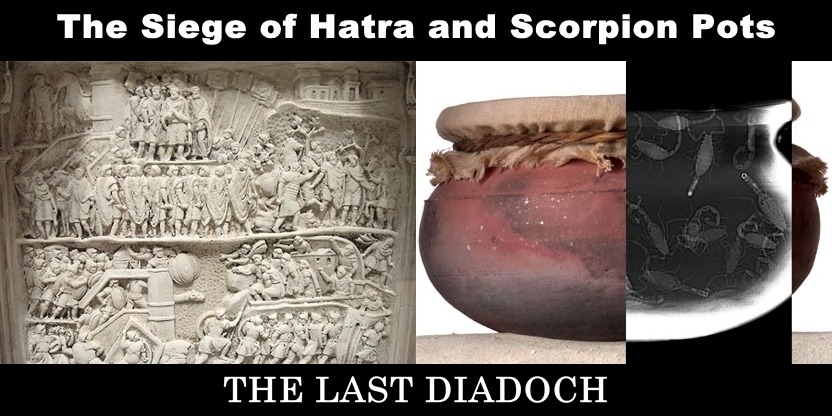
Read more about chucking invertebrates as a form of warfare HERE
 In his later career, the great Hannibal was forced to take employment as a jobbing, zero-hours, gigging, independant, external military consultant with Antiochous the Great of the Seleucid Kingdom. Knowing of Hannibals' great gifts as a land general Antiochous put him in charge of a fleet. It did not go well. Worried Antiochous was going to betray him to the Romans Hannibal burn this contract and signed  on with Prusias of Bithynia
(Is that what he said to Antiochous ? Ed.).
Undismayed by Hannibal's record on the briney, Prusias sent him to fight the Pergamenes,     at sea.

From Cornelius Nepos 'The Lives of the Great Commanders : Hannibal'

 ' They were to engage by sea in a few days; Hannibal was inferior in number of vessels, and had to use art in the contest, as he was no match for his enemy in force. He accordingly ordered as many poisonous serpents as possible to be brought together alive, and to be put into earthen vessels, of which when he bad collected a large number, he called the officers of his ships together, on the day on which he was going to fight at sea, and directed them all to make an attack upon the single ship of King Eumenes, and to be content with simply defending themselves against others, as they might easily do with the aid of the vast number of serpents;.........
 
......As the rest of the Pergamenian ships bore hard upon the enemy, the earthen pots, of which we have previously spoken, began suddenly to be hurled into them. These, when thrown, at first excited laughter among the combatants, nor could it be conceived why such a thing was done; but when they saw their ships filled with serpents, and, startled at the strangeness of the occurrence, knew not what to avoid first, they put about their ships, and retreated to their camp upon the coast '

Thus Hannibal achieved another victory by indirect means...

But the other star of the story is the snake ! And after years of obscurity, shunning the limelight - and the daylight-  it was found.. maybe.In Romania..in 2013
Link HERE
and in Sicily......in 2015

Link HERE
Actually it is not rare... just rare at the margins of its distribution, as all species tend to be...


But this snake was apparently used AS A PROJECTILE

 ' Scientists in Italy have come across the Javelin Sand Boa, a type of snake that the ancient Greeks used to hurl at their enemies as a projectile to create panic and confusion during sea battles.'

 Maybe a confusion with its species name which literally means 'throwable' but has been changed into its common name which is 'Javelin Boa'. Still a very throwy name.

Chucking them could be a problem - wriggly floppy snakes.. 

Maybe they fed them with Viagra before loading them into the catapults ?

sub-species Eryx jaculus ballisticus
 The truth is that they were immured in pots and the pots were thrown or shot to break and release the deadly serpents within so they could rampage through the packed ranks of rowers in the unfortunate Pergamene war-galleys.

In the ancient world it is was common to keep edible dormice in pots.
So the concept of pre-packaged delivery systems was nothing new.
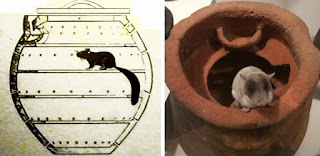
Like this only snakier .. or do I mean less ..snacky, If I was a Roman..

WWWWAAAIIITTTTTT!!!!!  ' Deadly serpents' !!???

Eryx jaculus - family Boidea - a boa. Boas are non-venemous. They crush their prey..this snake was how big ?  80cm ? !!!
VIPERS ABOVE  :  BOAS BELOW

 OK, no one ever remembers hearing 'Hannibal the Herpetologist who crossed the Alps with 100,000 men and a load of snakes' do they?   It was a unique error of judgement to incite serpenticide.  He is innocent. I blame the newspapers.

No Hannibal..... no no no ! They are on the WWF Red List ..not for use in warfare !

Actually, Hannibal was doing the Pergamenes a favour and treating their fleet to an antique version of a Rentokil visit. A shower of Eryx jaculus would do something to reduce the rodent population onboard a war-galley even if it did not take a toll on the crew!


Now, can we have some other candidates for Hannibal's snake ?  A viper of some kind ?

Contact details at Reprile Database .. HERE
Here is our boy ! A metre of viper with deadly venom - the Ottoman Viper, Montivipera xanthia.

Like Monty, doesn't suffer fools gladly. A touch aggressive if irritated. Range is eastern Aegean and eastern Turkey... fits the bill.
Now the small question of rounding them up and getting them into the pots.......