Saturday, 2 February 2013

RULES TEST

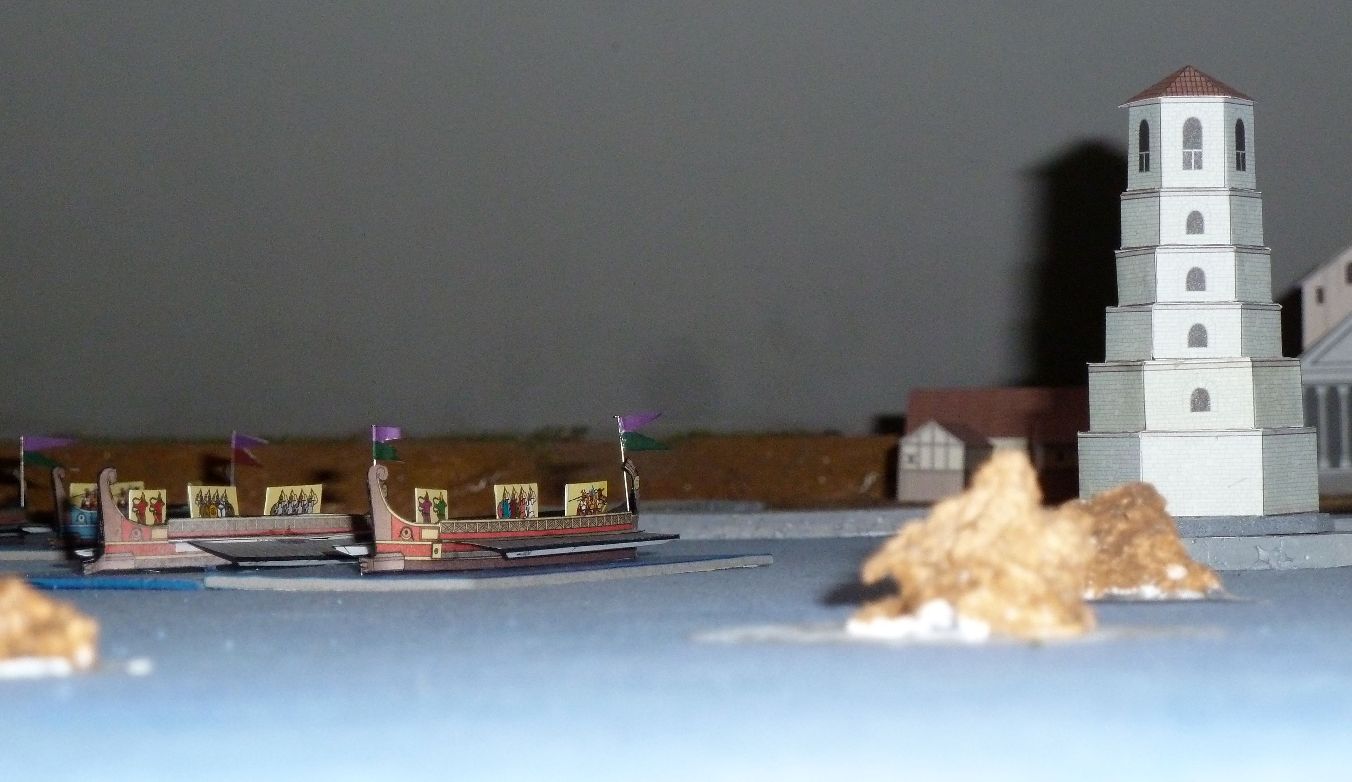
 ships now on bases, island state of Nauseos will defend itself
 ships are 66% of original size, figures still 6mm
HOTZ port looks good (printed 1/300)
 flags show sides and ship crew skill

 
 several small squadrons will take on nasty Athenian attackers

Wednesday, 23 January 2013

AGILITY

 http://vikingtoursdanske.weebly.com/uploads/1/3/3/6/13369496/header_images/1352200386.jpg
There has been some discussion on the net about Hotz Roman Seas Rules, especially their movement section. A lot seems to depend on interpreting how ships accelerate or decelerate. I don't have these rules because I don't like hex-based games. One point of discussion seems to be the opinion that galleys take a long time to stop in the water. My experience with viking galleys says this is wrong. The point to consider is that there is a tremendous amount of power in the propulsion system compared to the ship's mass and this propulsion system is dynamic: each side or individual levels can be put in reverse, stopped, or slowed.
 
Olympias could accelerate to 6 / 7 knots from a standing start in 30 seconds (making about 1,5 ship lengths) and could stop in about its own length from full speed of c.6 knots. (Athenian Trireme, Coates et al. 2000). This with an amateur crew.
Galley combat relied upon agility, with experienced captains and crew darting at each other and swerving and jinking to avoid collision. Collision would only be allowed to happen when conditions were right to achieve a deadly blow (or by accident) otherwise the attacker could be caught in the flank when stopped or as he reversed. If there were any complex considerations about deceleration curves or response times these tactics would not work.

Looking at the power/weight relationships of the various galley types one can see that a) the variation is not enormous 2) The trireme is supreme in the pre-Roman era and the Liburnian is small but extremely agile which goes some way to explain its supremacy in the Roman era. The viking Ladby ship is there for comparison. A fully loaded later viking warship may be much heavier with half as many oars again.

TYPE
OARSMEN
SHIP-LOADED WEIGHT
OARSMEN/TONNE
TRIERES
170
48 TONNES
3,5
HEMIOLIA
54
17.5
3,1
TETRERES
180
56
3,2
TRIHEMIOLIA
120
40
3,0
PENTERES
300
110
2,7
HEXERES
360
125
2,9
LIBURNIAN
54
10
5,4
Pentekonter
40
15
2,6
Bireme
48
15
3,2
Ladby Skibet
48(60)
6(15)
8(4)
(Data from 'The Age of the Galley' : Conways history of the ship)

Once Rome dominated on land its only opponents at sea had smaller, agile vessels which a 4 or 5 could not deal with but the liburnian could. The viking ship or pentekonter stand for 'tribal'  or pirate ships. Here one can see why larger ships were dropped in favour of the model which was not only seaworthy but nimble enough to tackle threats from raiders rather than a challenge to Roman might.

The main point is that it needs a good appreciation of the ancient ships' capabilities to make some realistic rules which at the same time need not be overcomplex.

Friday, 18 January 2013

Developments

Some more work on rules will be posted shortly.

Monday, 26 December 2011

Scale-satisfaction

Here is the late, great John Coates admiring a large model of Olympias (pic nicked from Guardian.co.uk) : obviously he preferred 1:1 modelling but what is the best compromise between aesthetics and practicality ?

Some nice pages to view small-scale ancient ship models are

Bob Lord's collection scale ? (small)

SteelonSandBlog has views and discussion of 1/3600 Outpost models

WABcorner Blog Valiant 1/900 and Langton 1/1200

Eric Hotz has produced Roman Seas in 1/300 but now appears to be answering demand from figure wargamers and is scaling them up to 15mm/10mm also.

To wargame a battle in the real age of galley warfare requires the fielding of circa 100 models.

Those 100 should be more than blobs and at the same time the table-top should be less than a football field.

Salamis involved circa 1200 ships in an area about 4km square.
This requires the following 'tables-tops':

1/300 : 13metres 1/900 : 4.4metres 1/1200 : 3.3metres 1/3600 : 1.1metres

1/3600 is obviously the best solution for those of us who don't live in a castle or have unfeasibly long arms. They are about 15p each. BUT the ships and overall aesthetic is more that of a map game. They are so small that they would even perhaps have to be based as groups?

1/300 is OUT except for skirmish games. HOWEVER I like the larger ships with easily visible detail and their cheepnis.

If 1/300 are reduced to 66% this gives 1/400 scale models with Salamis requiring a 10 metre table....apparently I can't have everything. Reduced Hotz ships cost me half an hour, ink, glue and card. Let's say 25p each.

1/1200 is also a good solution BUT 100 ships means circa 400 quid in outlay, painting and weight.

A funny thing is that I have not found any gamers on the net who have done some battles with c.100 ships ? Is everyone effectively doing skirmish wargaming ? even with small models ?

Sunday, 25 December 2011

Paper Quadrireme !

Amazing modelling of a quadrireme -- All the better because it is made in PAPER !

Sunday, 18 December 2011

Tri66

66% is the size I settled on. Look good. Relatively easy to make. The hemiolia is possible - stands in as a pentekonter/scout.66% is nearly 50 and gives nearly four times the playing surface.

An unexpected bonus is that the models stand alone and no base is needed. The oar-banks just need bending down a bit. I painted the undersides with pva glue and sprayed the models with matt varnish. The finished thing is quite strong and does not need such care in storage as do full-size models on bases.

Deck crew at this scale could be a problem but the 6mm card figures I made for full size models actually look quite ok. (phew)

Friday, 16 December 2011

Pros and Cons of Scaling-down

Pros
  1. Construction was not too onerous using shortcuts.
  2. Finished models still look far more 'lively' than lead
  3. Cost is very low : pence versus several quid for lead

Cons

  1. Construction time
  2. Do the shortcuts detract from the models?
  3. Deck troops..hmmm.. v.small. 6mm still look ok on 75% scale-down.