At Fine Scale Modeller. A great account of converting the diminutive old Heller kit of 1/225 biremes.
And then I found a remarkable and beautiful trieres carved from ivory ! And it was not alone......
This is the work of a master craftsman, David Warther II. He has carved ships since the age of 6 and has a museum containing an entire 'History of the Ship' in ivory. His technique includes scrimshaw and super-fine construction. All at 1/8" to the foot. STUNNING.
The most common scales for model galleys are 1/600 and 1/1200.
1/600 ships can look very nice with the extra space for detail and
one can put figure blocks on the decks to represent deck troops.
1/1200 ships are perfectly good but no longer have space enough to
accommodate figures or even a marker on their decks.
In terms of table space 1/600 gives a c.1km table edge on the
traditional 6x4 whilst 1/1200 gives c.2km.
A game with Athenians v Spartans
I decided that deck troops look good and wanted to use some figures.
The only options are 1/300 – 6mm figures and Irregular's 2mm range.
6mm is out straight away for these smaller scales. They look like
giants on 1/600 ships and collossi on 1/1200.
2mm being the only option it is immediately apparent that they are
too small on the 1/600 ships and still too large to use on 1/1200.
Basically, 1/1200 is a scale where one cannot use any kind of figures
or markers on deck.
What is 2mm scale ? If we take a fighter as 5'8” to six feet tall
in his boots and helmet then a 2mm figure is modelled at 1/900-1/800.
2mm deck fighters on 1/800 triereis
Now, to ground scale. A 40 metre 'Mark II' trieres at
1/1200 is 3.3cm long. At 1/600 this will be 6,6cm. I noticed that a
nice, round,5cm lies between,
at 1/800 – 40 metres
divided by 5cm is 800. Lo
and behold it is Irregular's scale....
The ground scale can be rounded to
1/1000 which gives a table side of 1.8km and makes translations from
maps easier.
But ships !? It is necessary to
produce one's own for this scale. However, this is not so bad as it
seems because they are not so fiddly as 1/1200 and not so
detail-demanding as 1/600. Maybe I will cast some in lead eventually
but until now they can be built from card, plastic and paper – and
plenty of glue and paint.
A jolly re-enactment of a Roman games at Nimes. In a Roman amphitheatre with thousands of spectators and hundreds of costumed re-enactors. Cleopatra and the Battle of Actium featured!
A 2016 article from Mail online. A colourful gallery of photos and a video to boot. HERE
The ships look like fun - I wonder how they were propelled ?
Belgians have no idea about the real thing....sigh...
Trieres included a maybe unexpected member of the crew. He was the auletes /αυλήτης or trieraules.
His purpose was to give the oarsmen the beat for their rowing rhythm. The instrument he played was the ancient two-pipe flute called the aulos.
The Poseidonia aulos
The auletes was used by the rowing master - the keleustes - to maintain a steady beat over time. In larger or later vessels a drum may have been used by an individual entitled the portisculus/pausarius - the hammer-wielder or beat-giver. The auletes used a strap-brace to keep the instrument in place.
When Olympias was on trials a tannoy system was implemented to allow direct and simultaneous communication with the whole crew. Getting 170 men to work in unison is no easy matter..
On each trial usually took some days before the oarsmen rowed properly in unison and once this basic standard was reached the necessity for communication was lessened. One must remember that the ancient crews grew up rowing and had the technique instilled in them. They needed occasional prompting not an ear-lashing to get them to work together and at the right rhythm.
'We're riding along on the crest of a wave...'
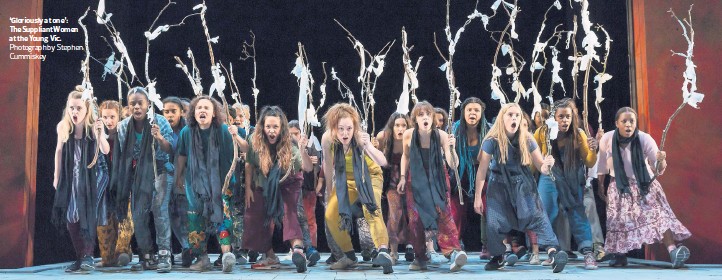
This year the Edinburgh Lyceum, in conjunction with the Actors Touring Company have a production of Aeschylus' 'The Suppliants' or 'Suppliant Women' directed by Ramin Gray. Passing over the rather tatty production values and the attempts to make modern political parallels, one aspect of the production is worthy of note. The music includes an aulos. The auletes for the production is Barnaby Brown and he spent a year learning the instrument. He was , of course an accomplished flautist already. The Chorus of the Greek theatre sang and danced to the aulos, and so too did the oarsmen work to it.
'Suppliant my arse - give them five minutes and they'll be telling you to tidy the house and change your underpants more often..'
Aeschylus, the renowned Athenian playwright, was not one of your modern Ivory Tower scribblers. In ancient Athens the Middle Class put their hoplons on the line for the city in order to maintain both their state and their status. Aeschylus definitely fought at Marathon and he may have fought at Salamis too - he would certainly have been present there. His brother lost a hand in the fighting. Listening to the aulos brought back to life by Barnaby Brown and others is to listen to the sound created by the auletes in the ships at Salamis. Not only that, but the all the galleys plying the seas of the Athenian Empire, the Black Sea and all over the Mediterranean. 170 sweaty, toiling men under the canopy of a trieres would share the drone and reedy wail of the aulos. They must have keenly eyed the auletes at the start of the voyage and hoped the new face knew his stuff - chaos and crumpled eardrums could otherwise ensue.
'Yes, Sire, I can confirm the Greeks are playing the theme from 'Das Boot', just to wind you up...'
There are some excellent videos of aulos playing on YOUTUBE. Shut your eyes and imagine you are resting on your oar and just listening to the auletes for a minute. No doubt he could also whistle up a festive tune for the evening to relax by.
VID 1 - Barnaby Brown does the technical stuff...
VID 2 - Barnaby Brown at the breathtaking temples of Pæstum.
VID 3 - If you survived the first two, this is a reward. Not such an accurate copy but a great musician playing a nice melody. Anton Platonov gives it gas. See his other aulos videos too.
There is also the triple pipe from Sardinia, still played today, but I am subjected to this regularly on CD by my girlfriend. It is not 50% better than the aulos. I would rather face the Persians than a bunch of pipe-wielding Sardinian shepherds!
Have a look at the blog 'One Sided Miniature Wargaming Discourse'for some galley action with Xyston and Hotz ships and Galleys and Galleons rules. HERE